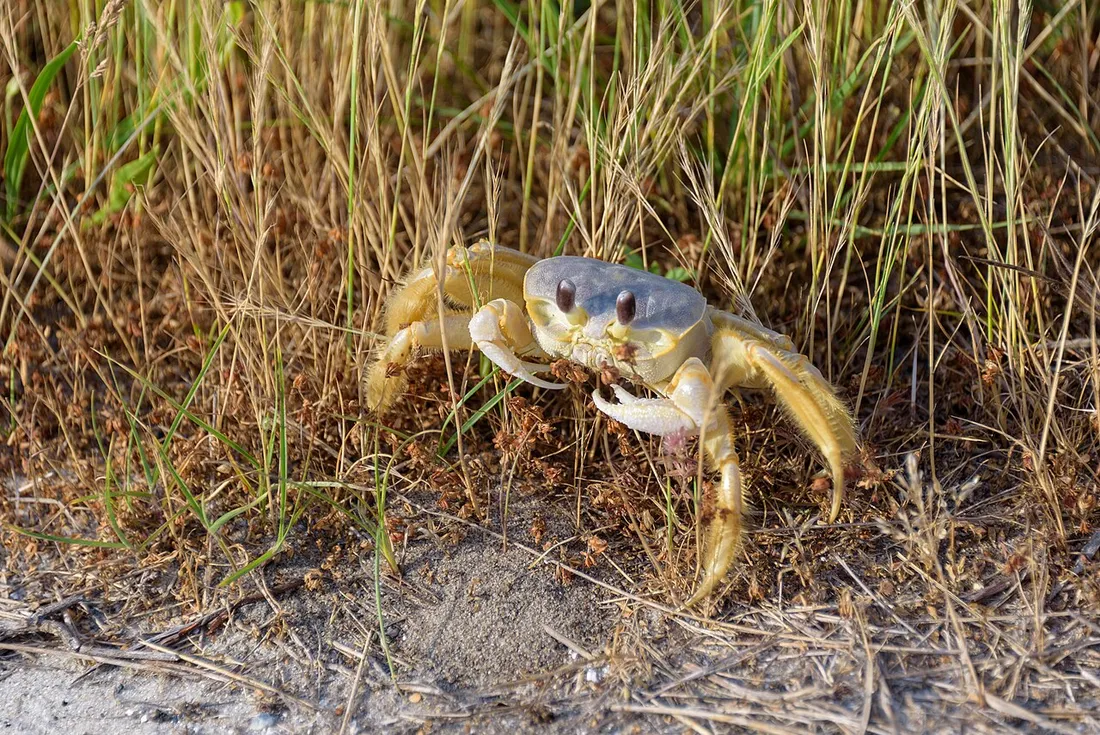
 Photo: Gordon Leggett · Image source ·CC BY-SA 4.0
_at_Assateague.jpg)
Animal profile · Crustaceans · Beach crab
Atlantic ghost crab
Ocypode quadrata
The Atlantic ghost crab is a pale, fast-moving crab of sandy beaches. It hides in deep burrows by day and hunts along the shore after sunset.
Not a fish · an aquatic neighborWater
Saltwater + Brackish
High sandy beaches, dunes, and protected estuarine shorelines.
Temperature
Range not established
A dependable species-specific wild temperature range was not established from the reviewed sources, so both values are null.
Size
Carapace about 5 cm (2 in) wide
About the size of a large cookie
Lifespan
Best-supported wild lifespan is not established.
Life expectancy varies with place, conditions, and what scientists have been able to observe.
01 · Signature adaptation
What does it do?
It is primarily nocturnal and may travel hundreds of meters while foraging. Its burrow can extend more than a meter underground and provides shelter from heat and predators.
02 · Home coordinates
Where does it live?
Atlantic beaches from the eastern United States through the Caribbean and along parts of South America.
Regions: Western Atlantic · Atlantic coast of North and South America
03 · The menu
What does it eat?
It searches beaches at night for small animals, eggs, and washed-up food.
Predator and scavenger: mole crabs, bean clams, turtle eggs, carrion, detritus.
04 · Remember this
Two wow facts
Underground home
A ghost crab’s burrow can be roughly 0.6–1.2 m (2–4 ft) long.
Sources [1]
Moisture wicks
Fine hairs at the bases of its legs help wick water from damp sand toward its gills.
Sources [1]