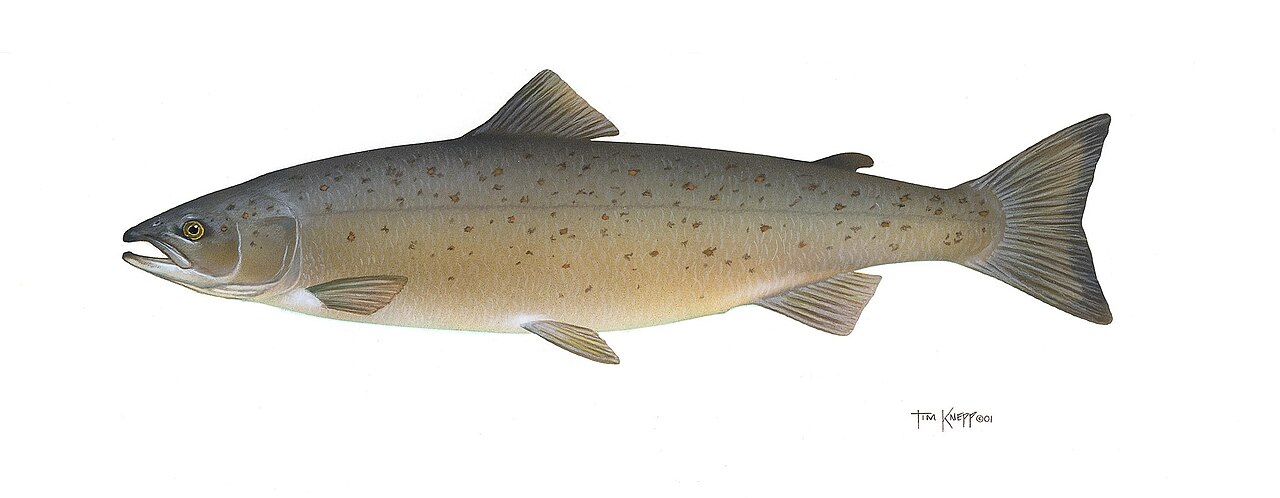
 Photo: Timothy Knepp, U.S. Fish and Wildlife Service · Image source ·Public domain (U.S. Fish and Wildlife Service)
Animal profile · Fish · Ray-finned fish
Atlantic salmon
Salmo salar
Atlantic salmon hatch in freshwater, may grow up in the ocean, and return to rivers to spawn. Their bodies transform so they can handle both fresh and salty water.
✓ This really is a fishWater
Freshwater + Brackish + Saltwater
Cold, clean rivers with gravel beds as youngsters and spawners, plus coastal and open North Atlantic waters as adults.
Temperature
4–18°C · 39–64°F
Needs cold, well-oxygenated water; the best temperature changes with life stage and season.
Size
Often 71–76 cm (28–30 in) after two years at sea
About the length of a baseball bat
Lifespan
Usually 4–6 years
Life expectancy varies with place, conditions, and what scientists have been able to observe.
01 · Signature adaptation
What does it do?
Young salmon shelter around river rocks before changing into silvery smolts and heading downstream. Unlike most Pacific salmon, an Atlantic salmon can survive spawning and make the trip again.
02 · Home coordinates
Where does it live?
Rivers connected to the North Atlantic in North America and Europe, followed by long feeding migrations into northern ocean waters.
Regions: North Atlantic Ocean · Northeastern North America · Europe · Iceland · Greenland · Russia
03 · The menu
What does it eat?
Young salmon eat insects and other small animals; ocean-going adults mainly eat fish.
Carnivore: aquatic insects, invertebrates, plankton, herring, smelt, capelin.
04 · Remember this
Two wow facts
A built-in river map
During smoltification, young salmon remember their river’s chemical signature, helping adults find their birthplace later.
Sources [1]
A possible second trip
Atlantic salmon do not always die after spawning. A small number return to sea and later spawn again.
Sources [1] [2]