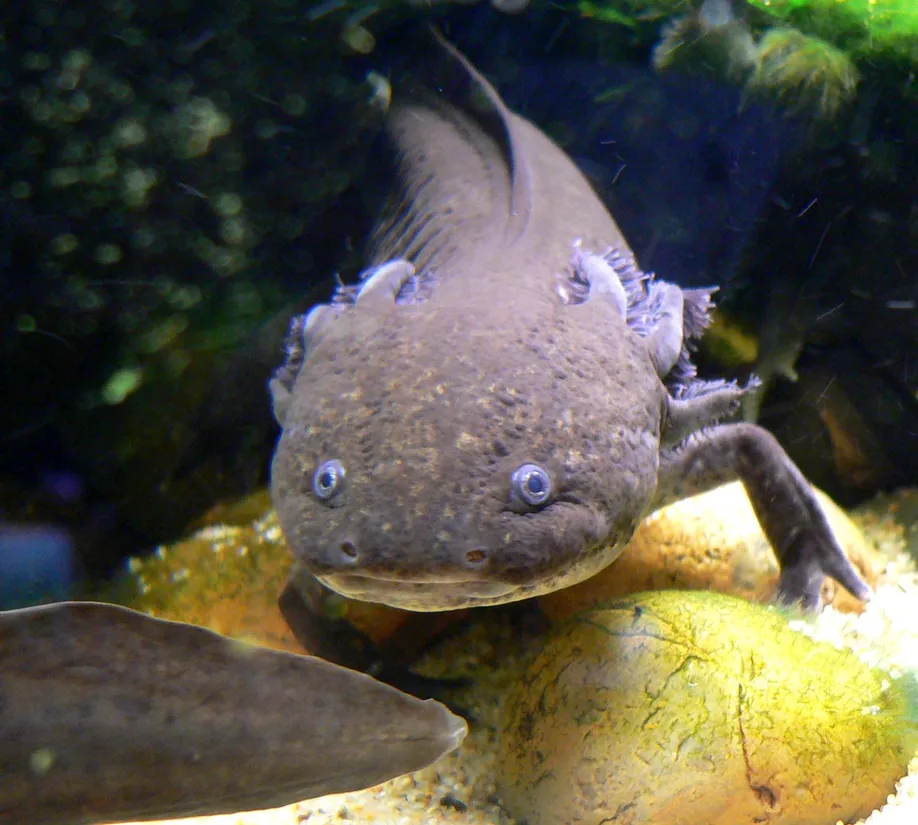
 Photo: Stan Shebs · Image source ·CC BY-SA 3.0
Animal profile · Other aquatic life · salamander
Axolotl
Ambystoma mexicanum
The axolotl is an aquatic salamander native to the Valley of Mexico. It usually keeps its larval body form throughout life while retaining feathery external gills.
Not a fish · an aquatic neighborWater
Freshwater
Freshwater canals and wetlands of the Xochimilco lake system near Mexico City.
Temperature
Range not established
A dependable species-specific wild temperature range was not established from the reviewed sources.
Size
Usually about 15–30 cm (6–12 in) long
About as long as a school ruler.
Lifespan
About 10–15 years in captivity; wild lifespan is poorly established
Life expectancy varies with place, conditions, and what scientists have been able to observe.
01 · Signature adaptation
What does it do?
It remains aquatic and generally does not undergo normal salamander metamorphosis. It is mostly solitary and moves along the bottom of canals and wetlands while hunting.
02 · Home coordinates
Where does it live?
Historically Lakes Chalco and Xochimilco in the Valley of Mexico; surviving wild populations are centered on Xochimilco wetlands.
Regions: Valley of Mexico · Xochimilco · Mexico City
03 · The menu
What does it eat?
It uses suction feeding to draw small prey into its mouth.
Carnivore: worms, insect larvae, small crustaceans, small aquatic animals.
04 · Remember this
Two wow facts
Never grows up
It retains larval features such as external gills while becoming sexually mature.
Sources [1] [2]
Regeneration expert
It can regenerate limbs and repair several complex tissues, making it important in biomedical research.
Sources [3] [4]