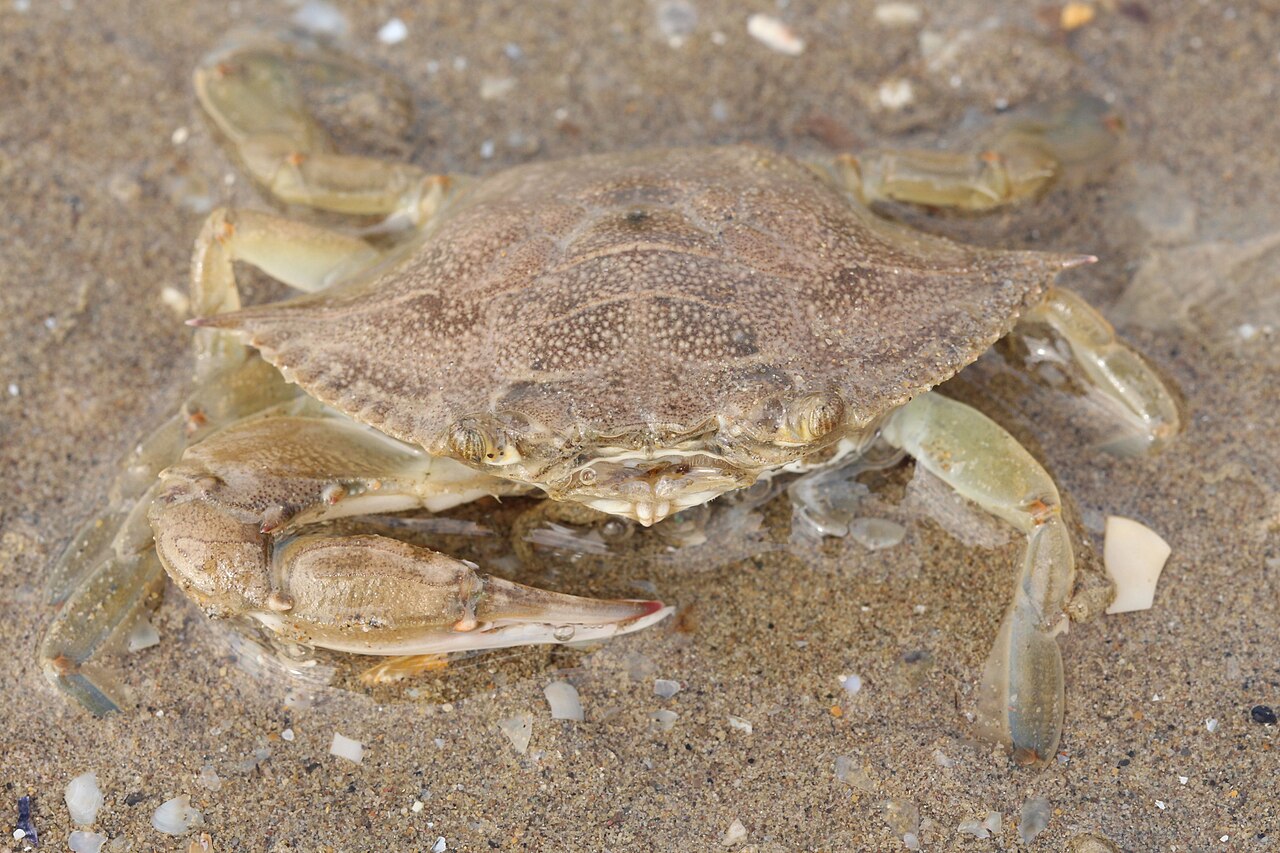
 Photo: Holger Krisp · Image source ·CC BY 3.0
Animal profile · Crustaceans · Swimming crabs
Blue crab
Callinectes sapidus
The blue crab is a fast-swimming crustacean with blue-tinted claws and an olive shell. It lives where rivers meet the sea and plays both predator and prey in coastal food webs.
Not a fish · an aquatic neighborWater
Brackish + Saltwater + Freshwater
Estuaries, bays, seagrass beds, oyster reefs, marshes, and nearshore waters from fresh river mouths to salty coasts.
Temperature
10–30°C · 50–86°F
Active across a broad seasonal range; in cold winters many burrow into deeper sediment.
Size
Up to about 23 cm (9 in) across the shell
About as wide as a dinner plate
Lifespan
Usually 3–4 years
Life expectancy varies with place, conditions, and what scientists have been able to observe.
01 · Signature adaptation
What does it do?
Blue crabs walk sideways on the bottom but can swim quickly when needed. They move among habitats with age, sex, salinity, and season, often hiding in grass beds or winter sediment.
02 · Home coordinates
Where does it live?
Native along the western Atlantic coast from Nova Scotia to Argentina, including estuaries and the Gulf coast; introduced populations live elsewhere.
Regions: Western Atlantic · Chesapeake Bay · Gulf coast · Introduced in other seas
03 · The menu
What does it eat?
It is an opportunistic feeder that eats living prey as well as plant and animal leftovers.
Omnivore: clams, oysters, mussels, small crustaceans, fish, detritus.
04 · Remember this
Two wow facts
Beautiful swimmer
Its scientific name is often translated as “beautiful savory swimmer,” a nod to its paddle-shaped back legs.
Sources [1]
Shell makeover
A hard shell cannot stretch, so the crab must crawl out of it and grow a new, larger shell. This process is called molting.
Sources [1] [2]