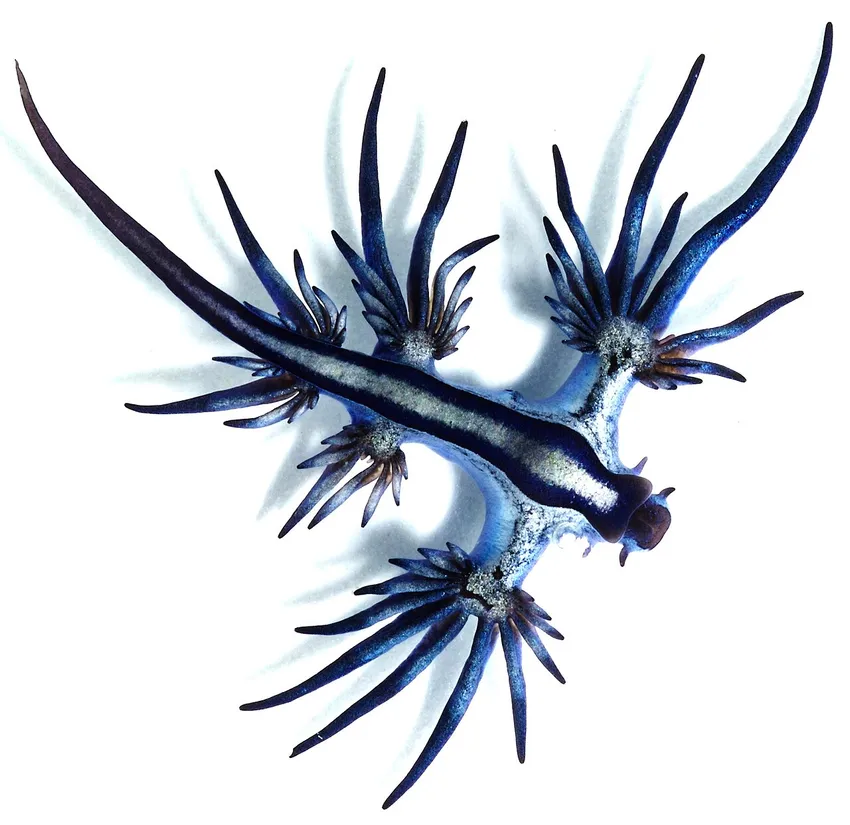
 Photo: Taro Taylor from Sydney, Australia · Image source ·CC BY 2.0
Animal profile · Mollusks · nudibranch
Blue dragon
Glaucus atlanticus
The blue dragon is a tiny pelagic nudibranch that floats upside down at the ocean surface. Its blue-silver coloring helps it blend with the bright sea around it.
Not a fish · an aquatic neighborWater
Saltwater
Open ocean surface waters carried by wind and currents.
Temperature
Range not established
A dependable species-specific wild temperature range was not found; values are left unreported.
Size
Usually up to about 3–4 cm (1.2–1.6 in)
About as long as a paperclip
Lifespan
Not established in the wild
Life expectancy varies with place, conditions, and what scientists have been able to observe.
01 · Signature adaptation
What does it do?
It floats upside down at the surface and drifts wherever currents and winds carry it. It can be painful to touch because stored stinging cells may still fire.
02 · Home coordinates
Where does it live?
Warm and temperate surface waters across the Atlantic, Indian, and Pacific oceans, with occasional records in the Mediterranean.
Regions: Atlantic Ocean · Indian Ocean · Pacific Ocean · Mediterranean Sea
03 · The menu
What does it eat?
It eats floating hydrozoans and concentrates their stinging cells in specialized body parts.
carnivore: Portuguese man-of-war, Velella, Porpita.
04 · Remember this
Two wow facts
Borrowed stingers
It can retain the stinging cells of its prey and deploy them later as a defense.
Sources [1]
Upside-down disguise
Its body orientation and contrasting colors help camouflage it from predators above and below.
Sources [1]