 Photo: Original uploader was Douglas Whitaker at en.wikipedia · Image source ·CC BY-SA 3.0
Animal profile · Crustaceans · Spiny lobster
Caribbean spiny lobster
Panulirus argus
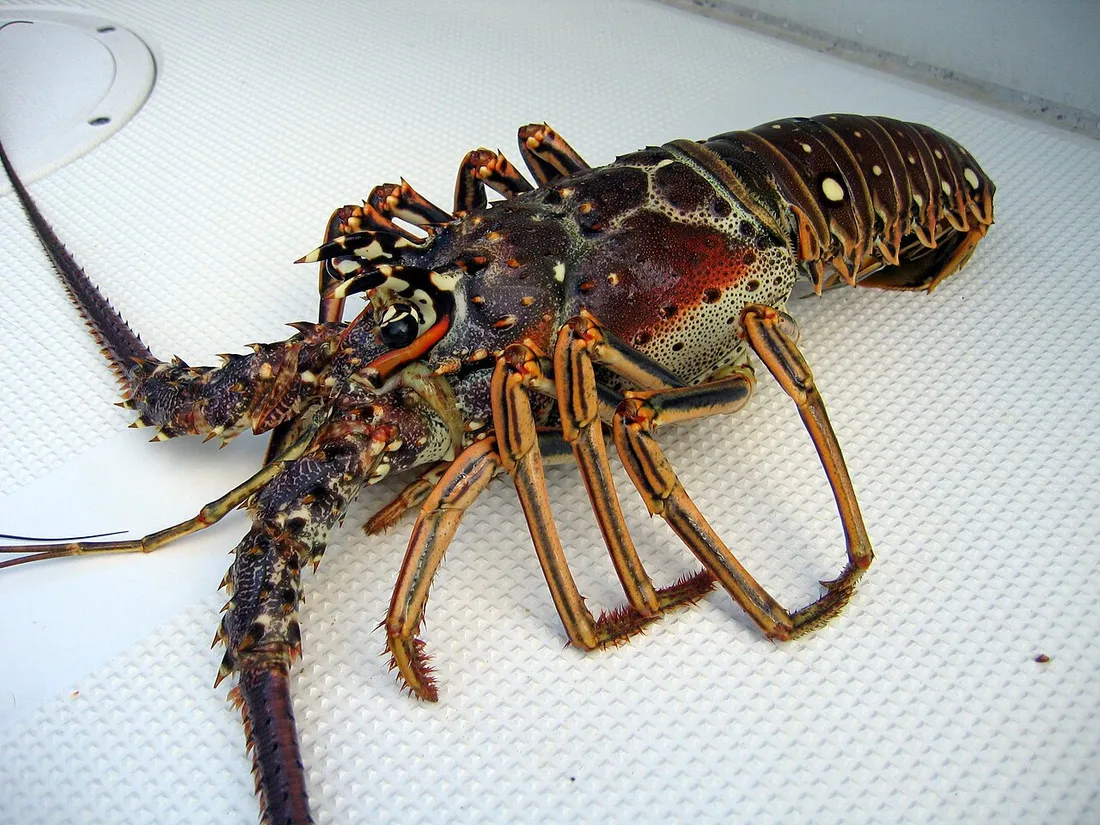
The Caribbean spiny lobster has a heavily spined body but no large front claws. It hides by day and searches coral reefs and seagrass beds at night.
Not a fish · an aquatic neighborWater
Saltwater + Brackish
Seagrass, mangroves, sponges, coral reefs, and rocky shelters.
Temperature
Range not established
A dependable species-specific wild temperature range was not established from the reviewed sources, so both values are null.
Size
Up to about 46 cm (18 in) and 6.8 kg (15 lb)
About as long as a school ruler
Lifespan
May live 15 years or more.
Life expectancy varies with place, conditions, and what scientists have been able to observe.
01 · Signature adaptation
What does it do?
It is nocturnal and shelters in crevices, sponges, and reef holes during the day. Adults may migrate in single-file groups toward deeper water when conditions become cold or turbid.
02 · Home coordinates
Where does it live?
North Carolina and Bermuda through the Gulf of Mexico, Caribbean, and south to Brazil.
Regions: Caribbean Sea · Gulf of Mexico · Western Atlantic
03 · The menu
What does it eat?
Juveniles and adults forage over the bottom for mollusks and other invertebrates, plus carrion.
Carnivore: snails, clams, crabs, sea urchins, carrion.
04 · Remember this
Two wow facts
No big claws
Unlike clawed lobsters, this species protects itself with body spines and very long antennae.
Sources [1]
Long larval journey
Its leaf-shaped larvae drift in the open ocean before settling into coastal nursery habitats.
Sources [1]