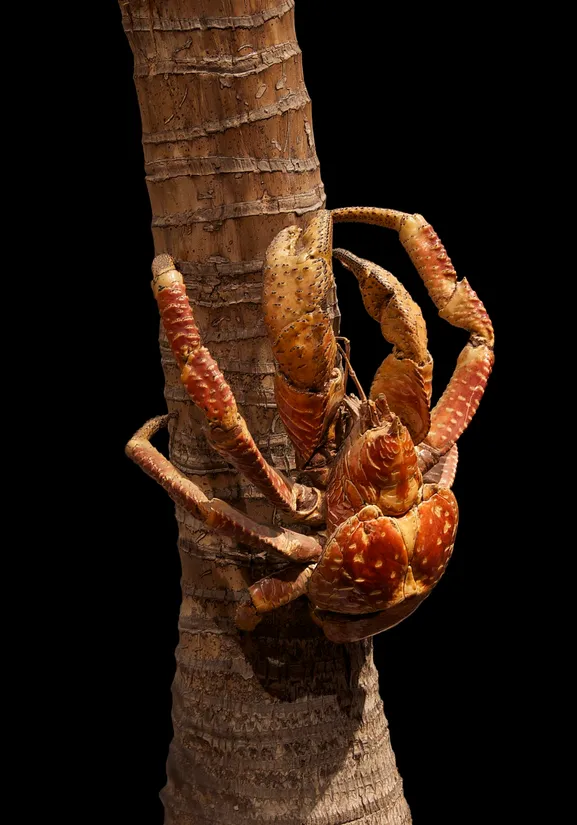
 Photo: Jebulon · Image source ·CC0
.jpg)
Animal profile · Crustaceans · Land crab
Coconut crab
Birgus latro
The coconut crab is the world’s largest land-dwelling crustacean. It lives on tropical islands and uses powerful claws to climb and handle tough food.
Not a fish · an aquatic neighborWater
Saltwater + Brackish
Tropical island forests, coastal scrub, and burrows near the sea.
Temperature
Range not established
A dependable species-specific wild temperature range was not established from the reviewed sources, so both values are null.
Size
Leg span up to about 1 m (3.3 ft); body length up to about 40 cm (16 in)
About as wide as a large serving tray
Lifespan
May reach maximum size after 40–60 years.
Life expectancy varies with place, conditions, and what scientists have been able to observe.
01 · Signature adaptation
What does it do?
Adults spend almost all their time on land but return to the sea to release larvae. They shelter in burrows and are mainly active at night.
02 · Home coordinates
Where does it live?
Tropical islands across the Indian Ocean and western Pacific.
Regions: Indian Ocean · Western Pacific islands
03 · The menu
What does it eat?
It climbs, forages on land, and uses its claws to tear or crush varied foods.
Omnivore and scavenger: fallen fruit, coconuts, seeds, carrion, small animals.
04 · Remember this
Two wow facts
Climbing crab
Coconut crabs can climb trees while searching for fruit and shelter.
Sources [1]
Slow giant
Some individuals take 40–60 years to reach their maximum size.
Sources [1]