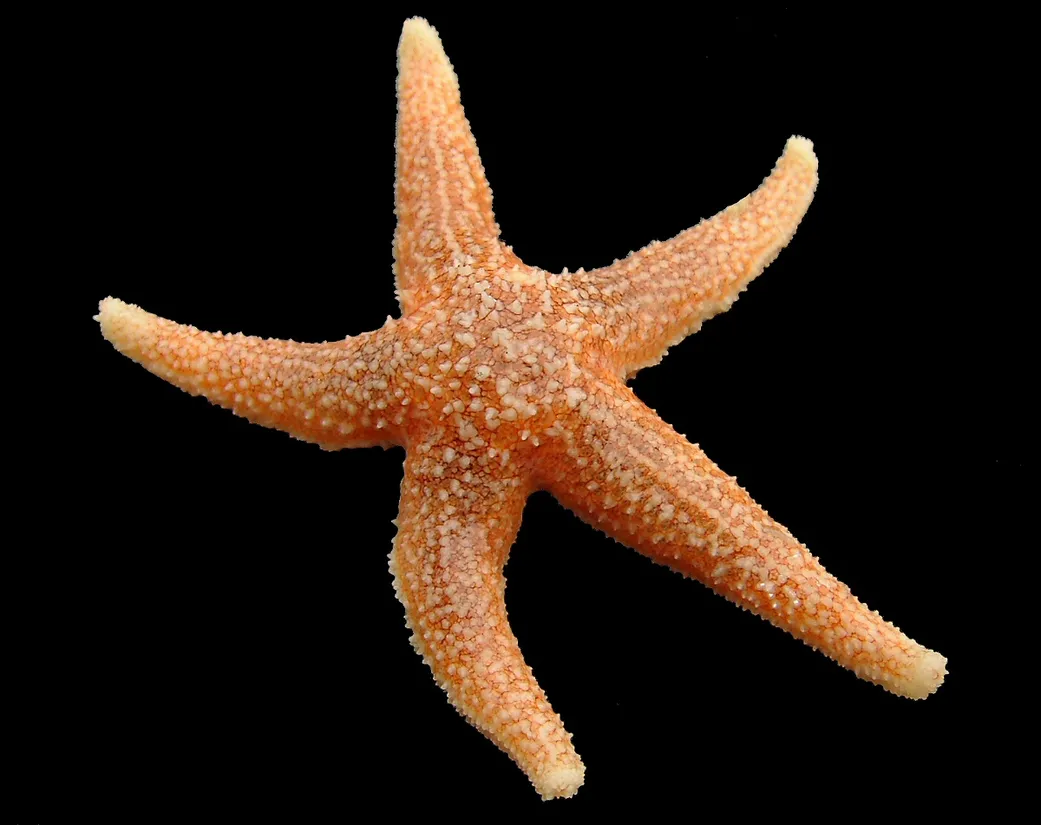
 Photo: © Hans Hillewaert · Image source ·CC BY-SA 4.0
Animal profile · Other aquatic life · sea star
Common sea star
Asterias rubens
The common sea star is a familiar five-armed predator of North Atlantic shores. It uses tube feet to move and to pull open bivalve shells.
Not a fish · an aquatic neighborWater
Saltwater + Brackish
Rocky shores, soft seabeds, mussel beds, rock pools, and shallow subtidal habitats.
Temperature
Range not established
A dependable species-specific wild temperature range was not established from the reviewed sources.
Size
Up to about 52 cm (20 in) across; commonly 10–30 cm (4–12 in)
A large individual can be about as wide as a dinner plate.
Lifespan
Not established in the wild
Life expectancy varies with place, conditions, and what scientists have been able to observe.
01 · Signature adaptation
What does it do?
It crawls over rocks and sediment using hundreds of tube feet. Its size and growth rate vary strongly with food availability.
02 · Home coordinates
Where does it live?
Northeastern Atlantic from Arctic Norway and the North Sea to Senegal, with occasional Mediterranean records.
Regions: northeastern Atlantic · North Sea · British Isles · Atlantic coast of Europe · Senegal
03 · The menu
What does it eat?
It pries open bivalves with tube feet and digests the soft tissues with an everted stomach.
Carnivore: mussels, clams, barnacles, other small invertebrates.
04 · Remember this
Two wow facts
Shell opener
Its tube feet can slowly pull mussel shells apart.
Sources [1] [2]
External digestion
It releases digestive juices onto prey after extending its stomach through a shell opening.
Sources [2]