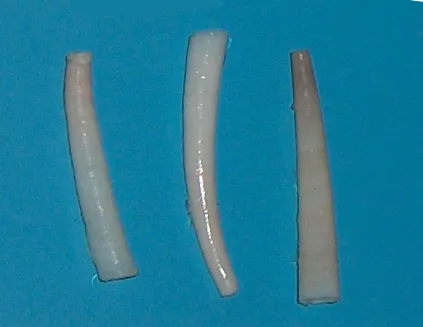
 Photo: Georges Jansoone ( JoJan ) · Image source ·CC BY 3.0
Animal profile · Mollusks · Scaphopod
Common tusk shell
Antalis vulgaris
Common tusk shells are slender marine mollusks with curved, tube-shaped shells open at both ends. They live buried in soft seafloor sediments and search through the sand for tiny prey.
Not a fish · an aquatic neighborWater
Saltwater
Soft sandy and muddy seafloors from shallow coastal water to deeper continental-shelf habitats.
Temperature
Range not established
A dependable species-specific wild temperature range was not found in the selected sources.
Size
About 3–6 cm (1.2–2.4 in) long
About the length of a paperclip
Lifespan
Not established in the wild.
Life expectancy varies with place, conditions, and what scientists have been able to observe.
01 · Signature adaptation
What does it do?
The animal usually stands partly buried in soft sediment with one end exposed to water. It has no obvious head or eyes and relies heavily on its captacula and radula while feeding.
02 · Home coordinates
Where does it live?
From southwestern Britain and nearby Atlantic European coasts to the western Mediterranean.
Regions: Western Europe · Atlantic coasts · Western Mediterranean
03 · The menu
What does it eat?
It extends adhesive captacula into the sediment to catch small organisms and particles.
Small-particle carnivore: foraminiferans, tiny benthic organisms, organic particles.
04 · Remember this
Two wow facts
Open at both ends
Its curved shell is a tube with openings at both ends, unlike the closed shells of most clams and snails.
Sources [3] [2]
Elephant-tusk look
The shell's smooth, tapering shape gives this small mollusk its tusk-shell name.
Sources [3] [4]