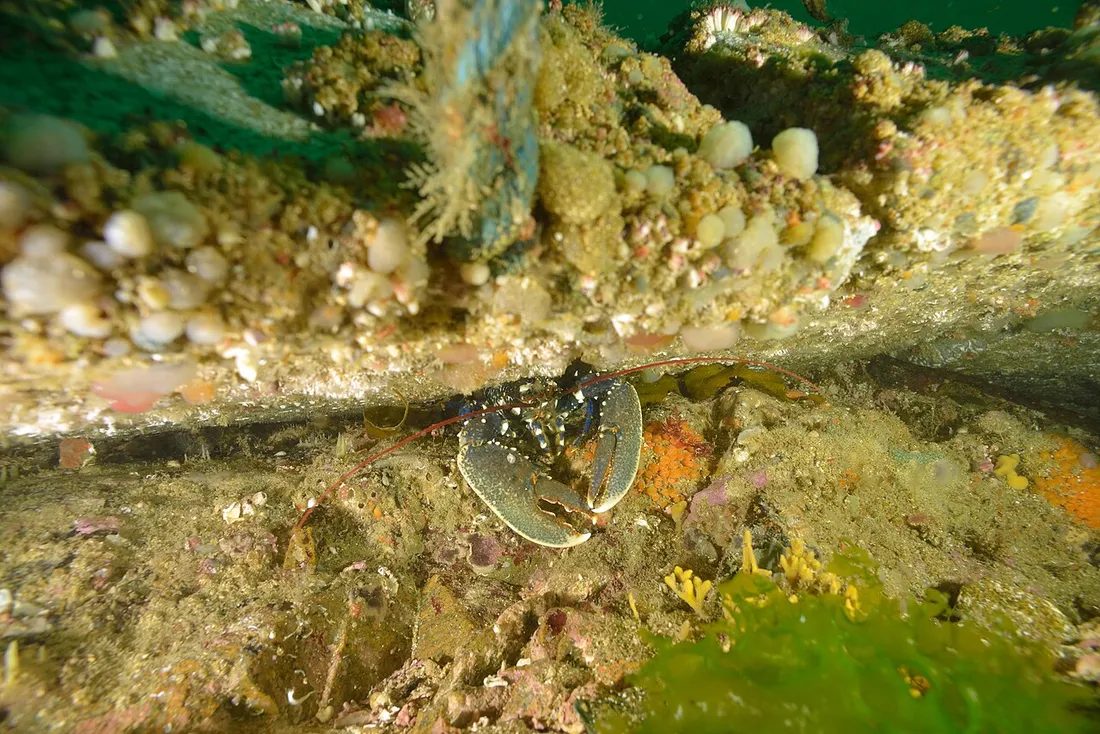
 Photo: Olivier Dugornay (Ifremer) · Image source ·CC BY 4.0
_(Ifremer_00737-84856_-_40917).jpg)
Animal profile · Crustaceans · Clawed lobster
European lobster
Homarus gammarus
The European lobster is a large clawed lobster of rocky Atlantic and Mediterranean coasts. Its shell is often blue-black before cooking, with a pale underside.
Not a fish · an aquatic neighborWater
Saltwater
Rocky reefs, crevices, and coastal seafloor.
Temperature
Range not established
A dependable species-specific wild temperature range was not established from the reviewed sources, so both values are null.
Size
Up to about 60 cm (24 in) long
About the length of a skateboard deck
Lifespan
Best-supported wild lifespan is not established.
Life expectancy varies with place, conditions, and what scientists have been able to observe.
01 · Signature adaptation
What does it do?
It is mainly nocturnal and usually hides in rocky shelters during daylight. Adults are generally solitary except during mating.
02 · Home coordinates
Where does it live?
Norway and the British Isles south through western Europe, North Africa, and the Mediterranean.
Regions: Northeast Atlantic · Mediterranean Sea
03 · The menu
What does it eat?
It walks over the bottom at night and grabs, crushes, or scavenges food.
Omnivore: mollusks, crabs, worms, fish, carrion.
04 · Remember this
Two wow facts
Colorful shell
Live European lobsters can have striking blue-black shells that look very different after cooking.
Sources [1]
Burrow dweller
Its flattened body and strong walking legs help it occupy narrow rocky shelters.
Sources [1]