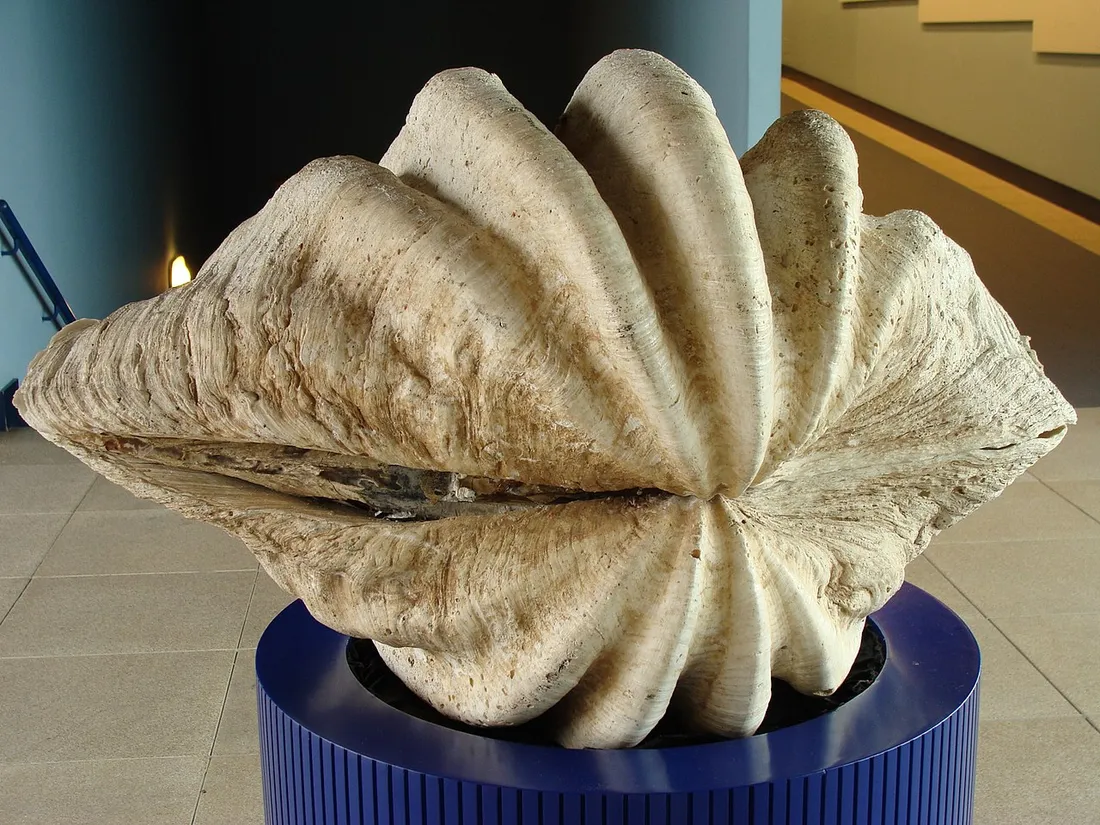
 Photo: Fernando Losada Rodríguez · Image source ·CC BY-SA 4.0
Animal profile · Mollusks · giant clam
Giant clam
Tridacna gigas
The giant clam is the largest living marine bivalve. It lives on tropical coral reefs and gains much of its energy from microscopic algae living in its mantle.
Not a fish · an aquatic neighborWater
Saltwater
Shallow tropical coral reefs, sand, and coral rubble.
Temperature
Range not established
A dependable species-specific wild temperature range was not found; values are left unreported.
Size
Up to about 1.3 m (4.3 ft) shell length and about 250 kg (550 lb)
About as long as a small bathtub
Lifespan
Not established in the wild
Life expectancy varies with place, conditions, and what scientists have been able to observe.
01 · Signature adaptation
What does it do?
It is sessile as an adult and remains attached to reef or rubble habitat. When startled, it retracts its mantle and closes its shell valves.
02 · Home coordinates
Where does it live?
Tropical Indo-Pacific coral reefs, including waters around Australia and many Pacific islands.
Regions: western Pacific Ocean · Great Barrier Reef · central Indo-Pacific
03 · The menu
What does it eat?
Adults combine nutrition from symbiotic algae with filter-feeding on tiny organisms in seawater.
mixotroph: symbiotic algae, phytoplankton, zooplankton.
04 · Remember this
Two wow facts
Bivalve heavyweight
It is the largest living marine bivalve, larger than any mussel, oyster, or scallop.
Sources [2] [3]
Living solar panel
Its colorful mantle houses algae that use sunlight to produce food for the clam.
Sources [1] [3]