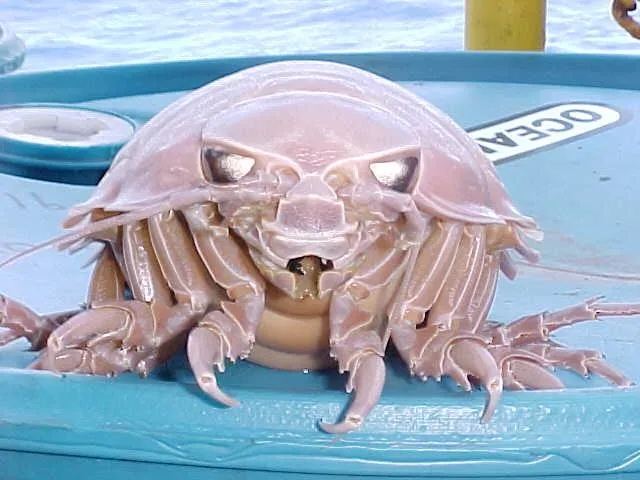
 Photo: friend of User:Borgx · Image source ·CC BY-SA 3.0
Animal profile · Crustaceans · Deep-sea isopod
Giant isopod
Bathynomus giganteus
The giant isopod is a huge relative of the familiar pill bug. It crawls across the deep seafloor and scavenges animals that sink from above.
Not a fish · an aquatic neighborWater
Saltwater
Deep bathyal seafloor, soft sediment, and continental slopes.
Temperature
Range not established
The reviewed source gives an approximate habitat temperature, but not a dependable complete wild species range; both values are null.
Size
About 28–50 cm (11–20 in) long
About as long as a small skateboard
Lifespan
Best-supported wild lifespan is not established.
Life expectancy varies with place, conditions, and what scientists have been able to observe.
01 · Signature adaptation
What does it do?
It often lies still or buries itself in sediment to conserve energy. Its armored body can curl into a defensive ball around the softer underside.
02 · Home coordinates
Where does it live?
Deep Atlantic and Indo-Pacific waters, including the Gulf of Mexico and continental slopes.
Regions: Atlantic Ocean · Indo-Pacific deep sea
03 · The menu
What does it eat?
It searches the seafloor for carrion and occasionally attacks slow-moving animals.
Carnivorous scavenger: dead fish, dead squid, whale falls, sea cucumbers, sponges.
04 · Remember this
Two wow facts
Largest isopod
Bathynomus giganteus is the largest known isopod species.
Sources [1]
Deep-sea giant
It lives from roughly 170 m to more than 2,000 m deep, far below ordinary beach life.
Sources [1]