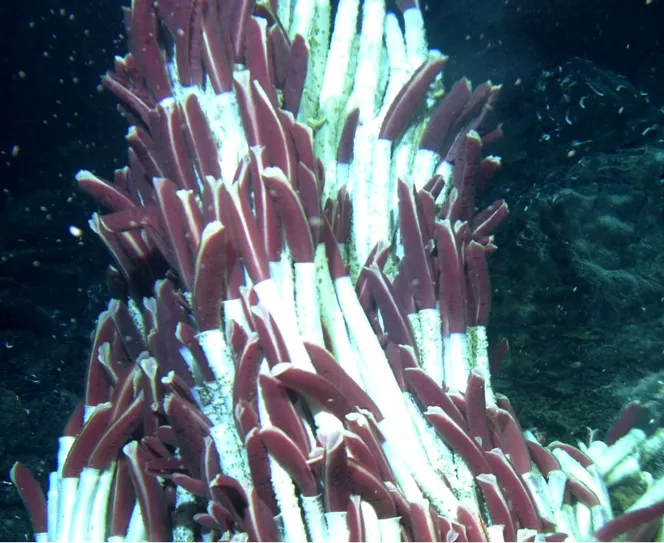
 Photo: Sabine Gollner et al. · Image source ·CC BY 2.5
Animal profile · Other aquatic life · hydrothermal-vent worm
Giant tube worm
Riftia pachyptila
The giant tube worm lives around deep-sea hydrothermal vents in the Pacific. It has no mouth or digestive tract and depends on bacteria living inside its body.
Not a fish · an aquatic neighborWater
Saltwater
Dense colonies around deep hydrothermal vents on oceanic ridges.
Temperature
Range not established
A dependable species-specific wild temperature range was not established from the reviewed sources.
Size
Over 1.5 m (5 ft) long; some sources report more than 1.8 m (6 ft)
About as long as a tall adult is high.
Lifespan
Not established in the wild
Life expectancy varies with place, conditions, and what scientists have been able to observe.
01 · Signature adaptation
What does it do?
It anchors itself in a tough tube near active vents and grows in dense clusters. The plume extends into seawater to exchange gases and dissolved chemicals.
02 · Home coordinates
Where does it live?
Deep hydrothermal vents of the East Pacific Rise and Galápagos Rift.
Regions: East Pacific Rise · Galápagos Rift · Pacific hydrothermal vents
03 · The menu
What does it eat?
Bacteria in its trophosome use chemicals from vent fluids to produce organic nutrients for the worm.
Chemosymbiotic: food produced by sulfur-oxidizing symbiotic bacteria.
04 · Remember this
Two wow facts
No mouth
It has no mouth or gut and receives nutrition from internal symbiotic bacteria.
Sources [1] [2]
Rapid growth
It can reach almost 5 feet long in less than two years.
Sources [3]