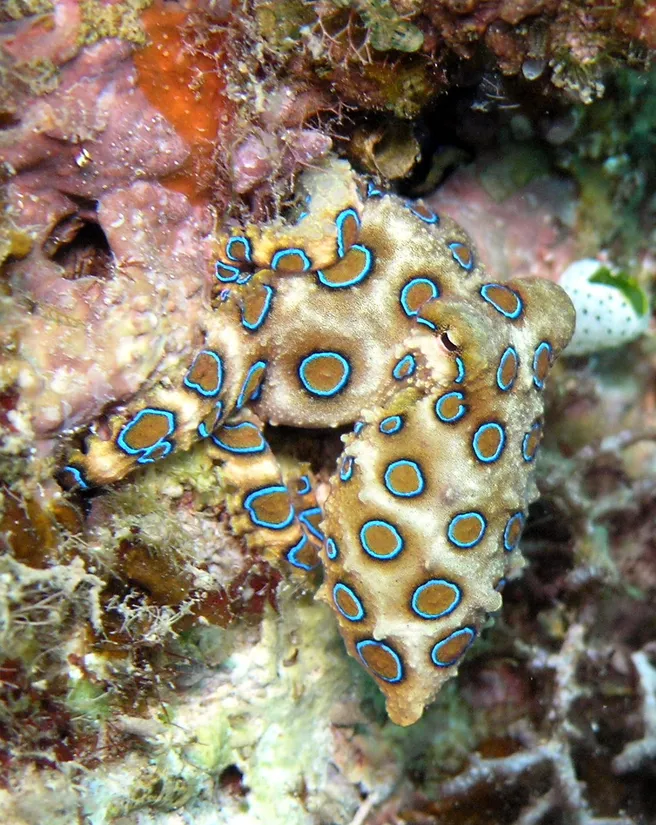
 Photo: Jens Petersen · Image source ·CC BY 2.5
Animal profile · Mollusks · Octopus
Greater blue-ringed octopus
Hapalochlaena lunulata
The greater blue-ringed octopus is a small tropical octopus marked with brilliant blue rings. Its venom contains tetrodotoxin, so this beautiful animal should never be touched.
Not a fish · an aquatic neighborWater
Saltwater
Shallow tropical seabeds around coral reefs, rubble, sand, and rocky crevices.
Temperature
Range not established
A dependable species-specific wild temperature range was not found.
Size
About 12 cm (4.7 in) including the arms
About as long as a child’s hand
Lifespan
Not established in the wild; females reproduce once and die after their eggs hatch.
Life expectancy varies with place, conditions, and what scientists have been able to observe.
01 · Signature adaptation
What does it do?
It is generally solitary and hides in crevices or a small den. It is active around daylight and displays its blue rings when alarmed.
02 · Home coordinates
Where does it live?
Indo-West Pacific waters from Sri Lanka and Indonesia through the Philippines to northern Australia, Papua New Guinea, Vanuatu, and the Solomon Islands.
Regions: Indo-West Pacific · Australia · Southeast Asia · Melanesia
03 · The menu
What does it eat?
It uses a venomous bite to subdue small seafloor prey before eating it with its beak.
Carnivore: crabs, shrimp, stomatopods, snails, small fish.
04 · Remember this
Two wow facts
Deadly saliva
Tetrodotoxin in its saliva can paralyze prey and is dangerous to people.
Sources [1] [2]
One-time motherhood
A female guards her eggs until they hatch and then dies, completing her one reproductive cycle.
Sources [1]