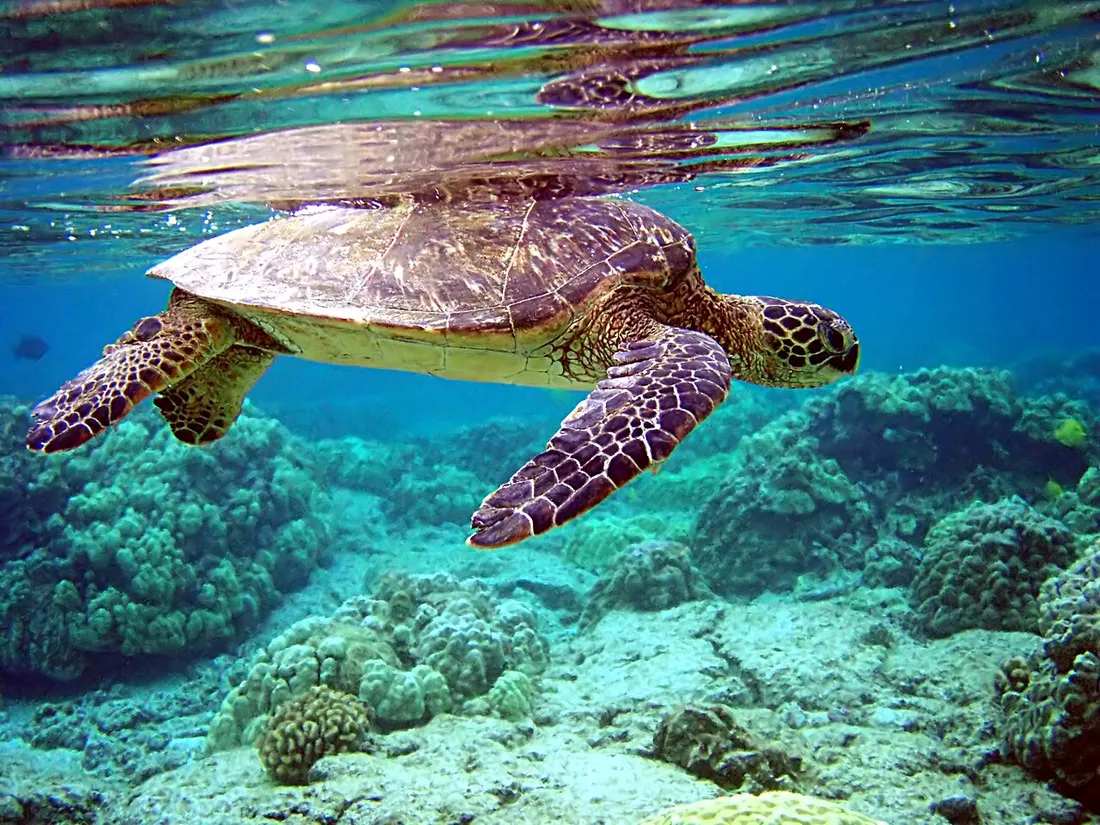
 Photo: Brocken Inaglory · Image source ·CC BY-SA 4.0
Animal profile · Other aquatic life · sea turtle
Green sea turtle
Chelonia mydas
The green sea turtle is the largest hard-shelled sea turtle. Adults often graze on seagrass and algae, helping shape productive coastal meadows.
Not a fish · an aquatic neighborWater
Saltwater
Tropical and subtropical coastal waters, seagrass beds, coral reefs, lagoons, and nesting beaches.
Temperature
Range not established
A dependable species-specific wild temperature range was not established from the reviewed sources.
Size
Adults about 0.9–1.2 m (3–4 ft) long and 113–181 kg (250–400 lb)
A large adult can weigh about as much as two refrigerators.
Lifespan
Often estimated at 70 years or more
Life expectancy varies with place, conditions, and what scientists have been able to observe.
01 · Signature adaptation
What does it do?
It migrates between feeding grounds and nesting beaches, sometimes crossing entire ocean basins. Females return to land to lay eggs, while adults spend most of their lives in the sea.
02 · Home coordinates
Where does it live?
Tropical and subtropical oceans worldwide, with nesting and feeding sites on many coastlines.
Regions: Atlantic Ocean · Pacific Ocean · Indian Ocean · Mediterranean Sea
03 · The menu
What does it eat?
Adults primarily graze marine vegetation, while juveniles are more omnivorous.
Herbivore: seagrass, seaweed, marine algae.
04 · Remember this
Two wow facts
Green fat
Its common name refers to the greenish color of its body fat, not the color of its shell.
Sources [1]
Plant-eating turtle
It is the only sea turtle species whose adults are primarily herbivorous.
Sources [1]