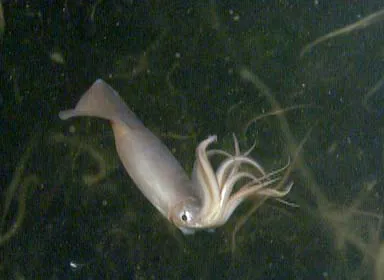
 Photo: Image courtesy of NOAA/MBARI 2006 · Image source ·Public domain
Animal profile · Mollusks · Squid
Humboldt squid
Dosidicus gigas
The Humboldt squid is a large, active predator of the eastern Pacific Ocean. It forms groups and makes daily vertical migrations through the water column.
Not a fish · an aquatic neighborWater
Saltwater
Open coastal and offshore waters, especially productive upwelling regions.
Temperature
Range not established
A dependable species-specific wild temperature range was not found.
Size
Up to about 1.5 m (5 ft) mantle-and-arm length
About as long as a tall refrigerator
Lifespan
Usually about 1 year, with some individuals living roughly 1–2 years.
Life expectancy varies with place, conditions, and what scientists have been able to observe.
01 · Signature adaptation
What does it do?
It often travels in schools and migrates vertically, feeding nearer the surface at night. It is a fast swimmer and can be aggressive toward prey and competitors.
02 · Home coordinates
Where does it live?
Eastern Pacific waters from the Gulf of California and California to Peru and Chile.
Regions: Eastern Pacific Ocean · Gulf of California · Peru · Chile
03 · The menu
What does it eat?
It uses two long tentacles and eight arms to seize prey, often attacking quickly in groups.
Carnivore: fish, anchovies, Pacific hake, other squid, crustaceans.
04 · Remember this
Two wow facts
Daily elevator ride
It can move through hundreds of meters of the water column during daily vertical migrations.
Sources [1] [2]
Color communicator
Rapid skin-color changes are used in interactions with other squid and during hunting or defensive displays.
Sources [1] [2]