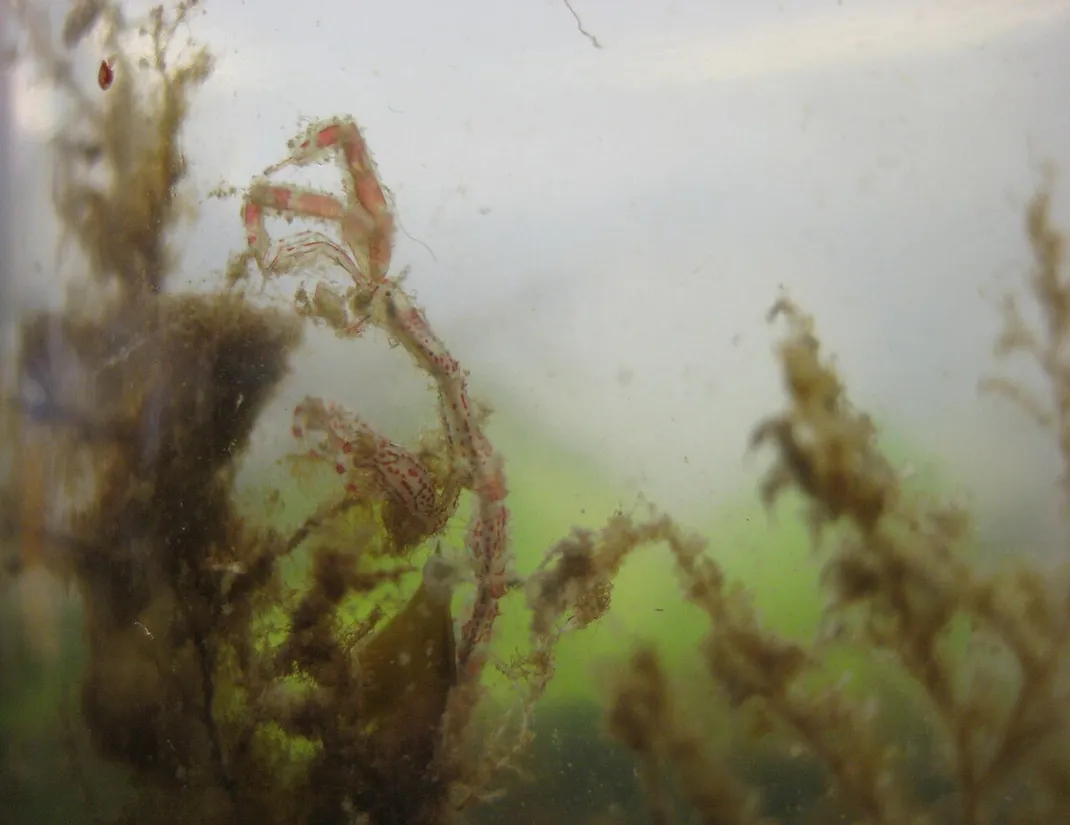
 Photo: Bensha24 · Image source ·Public domain
Animal profile · Crustaceans · Caprellid amphipod
Japanese skeleton shrimp
Caprella mutica
The Japanese skeleton shrimp is a thin, stick-like amphipod that clings to algae, hydroids, ropes, and boat hulls. It is native to the northwest Pacific and invasive in many other regions.
Not a fish · an aquatic neighborWater
Saltwater
Sheltered bays, macroalgae, hydroids, bryozoans, aquaculture gear, and artificial structures.
Temperature
Range not established
A dependable species-specific wild temperature range was not established from the reviewed sources, so both values are null.
Size
Up to about 5 cm (2 in) long
About the length of a paperclip
Lifespan
Best-supported wild lifespan is not established.
Life expectancy varies with place, conditions, and what scientists have been able to observe.
01 · Signature adaptation
What does it do?
It remains attached to vegetation or structures for much of its life. Dense introduced populations can compete with native amphipods and foul aquaculture equipment.
02 · Home coordinates
Where does it live?
Native to the Sea of Japan and northwest Pacific; introduced across Europe, North America, and New Zealand.
Regions: Northwest Pacific · Introduced North Atlantic and North Pacific
03 · The menu
What does it eat?
It scrapes particles from surfaces and filters food from the water with bristled appendages.
Detritivore and suspension feeder: detritus, plankton, hydroids, small benthic organisms.
04 · Remember this
Two wow facts
Living coat hanger
It can rapidly colonize ropes, boat hulls, aquaculture facilities, and offshore structures.
Sources [1]
Tiny filterer
Its bristled appendages can sieve particles from the water column.
Sources [1]