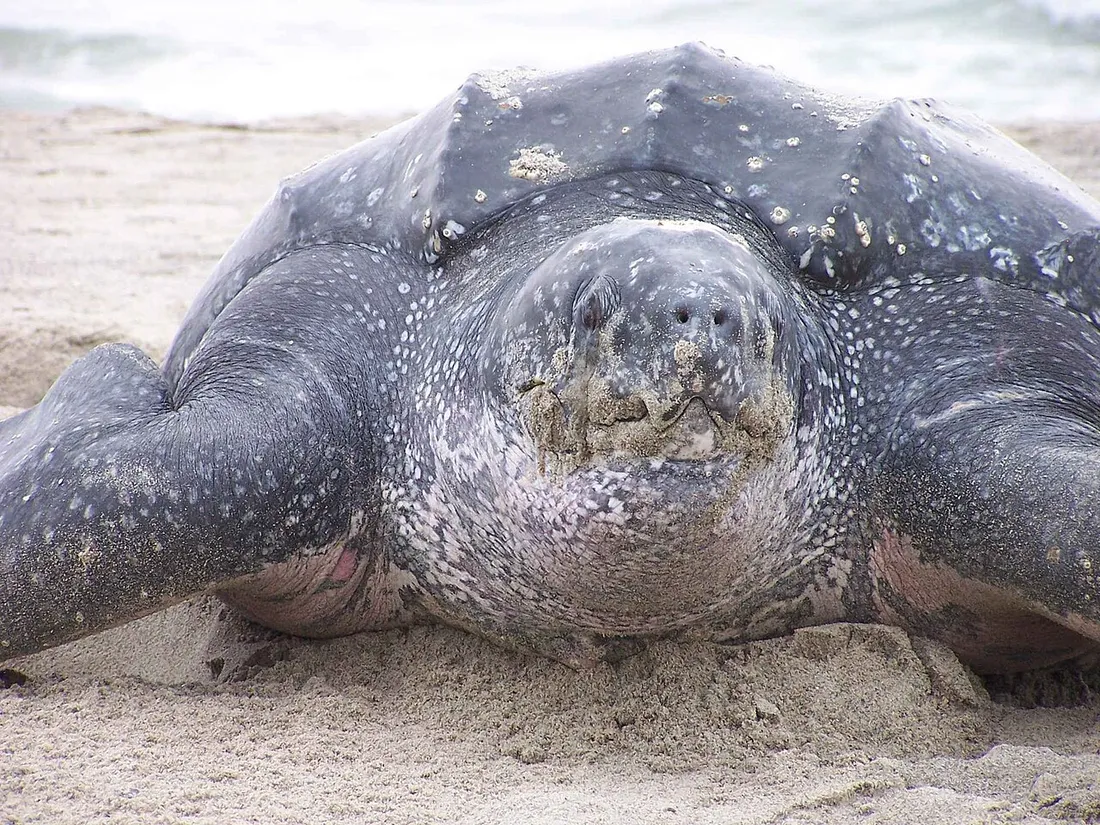
 Photo: Rabon David, U.S. Fish and Wildlife Service · Image source ·Public domain
Animal profile · Other aquatic life · sea turtle
Leatherback sea turtle
Dermochelys coriacea
The leatherback sea turtle is the largest living turtle and the only sea turtle without a hard shell. Its flexible, ridged skin-covered carapace supports long migrations through open ocean.
Not a fish · an aquatic neighborWater
Saltwater
Open ocean, continental shelves, jellyfish-rich waters, and tropical nesting beaches.
Temperature
Range not established
A dependable species-specific wild temperature range was not established from the reviewed sources.
Size
Adults about 1.5–1.8 m (5–6 ft) long and 340–454 kg (750–1,000 lb)
A large adult can weigh about as much as a small car.
Lifespan
Estimated at 50 years or more
Life expectancy varies with place, conditions, and what scientists have been able to observe.
01 · Signature adaptation
What does it do?
It makes some of the longest migrations of any sea turtle between nesting and feeding areas. It can dive to about 1,200 m (4,000 ft) and remain submerged for up to 85 minutes.
02 · Home coordinates
Where does it live?
Worldwide tropical, subtropical, and temperate oceans.
Regions: Atlantic Ocean · Pacific Ocean · Indian Ocean · tropical nesting coasts
03 · The menu
What does it eat?
It uses backward-pointing throat papillae to retain soft gelatinous prey.
Specialized carnivore: jellyfish, salps, other gelatinous animals.
04 · Remember this
Two wow facts
Deepest turtle diver
It can dive to approximately 4,000 feet, deeper than any other sea turtle.
Sources [1]
Jellyfish specialist
Its diet is dominated by jellyfish and other gelatinous animals.
Sources [1] [2]