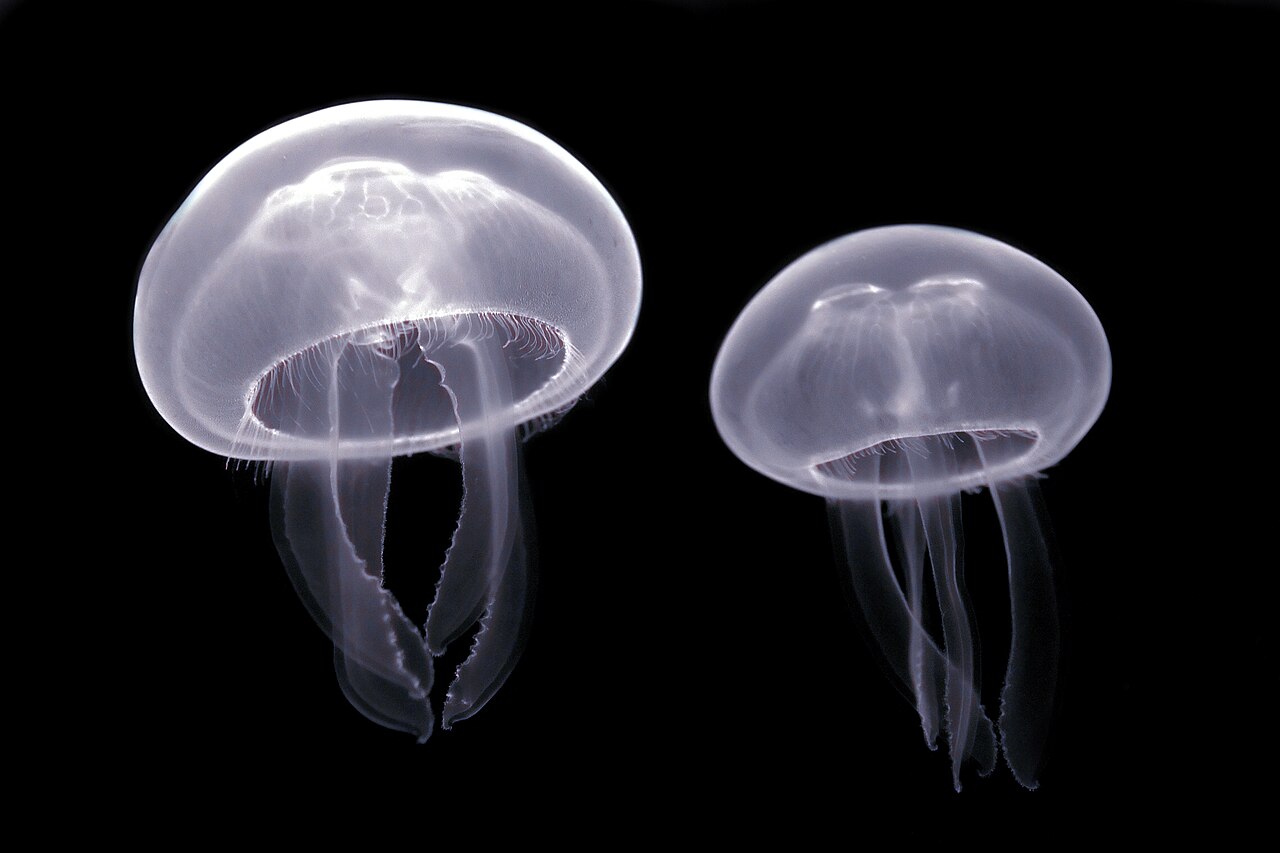
 Photo: Luc Viatour · Image source ·CC BY-SA 3.0
_Luc_Viatour.jpg)
Animal profile · Other aquatic life · Jellies and corals
Moon jelly
Aurelia aurita
The moon jelly is a soft, see-through animal whose round bell glows like a moon underwater. It has no brain, heart, bones, or true fish parts, yet it senses and survives in seas around the world.
Not a fish · an aquatic neighborWater
Saltwater + Brackish
Coastal and open marine water, especially temperate and tropical bays, harbors, and seas.
Temperature
9–26°C · 48–79°F
A broad observed temperate-to-tropical range; Aurelia species and local populations differ.
Size
Often 15–30 cm (6–12 in) across the bell
From dessert-plate to dinner-plate size
Lifespan
The swimming medusa usually lives for months; the polyp stage can persist longer
Life expectancy varies with place, conditions, and what scientists have been able to observe.
01 · Signature adaptation
What does it do?
Moon jellies pulse their bells but are carried largely by currents. They can gather into large swarms where food and water conditions concentrate them.
02 · Home coordinates
Where does it live?
Widely reported in temperate and tropical seas, although look-alike Aurelia species make exact boundaries difficult to map.
Regions: Atlantic Ocean · Pacific Ocean · Indian Ocean · Many coastal seas
03 · The menu
What does it eat?
Fine tentacles and sticky mucus collect tiny drifting animals and move them toward the mouth.
Plankton eater: zooplankton, tiny crustaceans, fish eggs, small larvae.
04 · Remember this
Two wow facts
Mostly water
About 95 percent of a moon jelly’s body is water, helping its delicate bell stay nearly transparent.
Sources [1]
Many shapes in one life
A moon jelly changes from a tiny swimming larva to a stuck-down polyp, then releases young jellies that grow into adults.
Sources [1] [2]