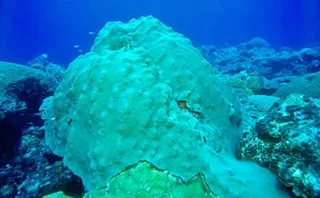
 Photo: NOAA - Joyce and Frank Burek · Image source ·Public domain
.jpg)
Animal profile · Other aquatic life · Stony coral
Mountainous star coral
Orbicella faveolata
Mountainous star coral forms massive, lumpy colonies that helped build Caribbean reefs. Its tiny polyps live with symbiotic algae and grow slowly in tropical reef environments.
Not a fish · an aquatic neighborWater
Saltwater
Tropical coral reefs from shallow water to mesophotic reef zones.
Temperature
Range not established
No dependable species-specific wild temperature range was located.
Size
Colonies commonly form metre-scale mounds, about 1–3 m (3–10 ft) across
A mature colony can be as wide as a small room.
Lifespan
Colonies can live for hundreds of years
Life expectancy varies with place, conditions, and what scientists have been able to observe.
01 · Signature adaptation
What does it do?
It is a hermaphroditic broadcast spawner that releases eggs and sperm once each year. Growth is slow, generally about 1 cm per year, and larvae settle on hard surfaces to start new colonies.
02 · Home coordinates
Where does it live?
Caribbean Sea, Gulf of Mexico, southern Florida, and associated western Atlantic reef habitats.
Regions: Caribbean Sea · Gulf of Mexico · Southern Florida · Bahamas
03 · The menu
What does it eat?
Its polyps capture plankton, while symbiotic algae supply sugars made by photosynthesis.
Mixotroph: plankton, sugars from symbiotic algae.
04 · Remember this
Two wow facts
Once a reef dominant
It was historically one of the primary builders of Caribbean reef framework.
Sources [1]
Slow and ancient
Colonies grow about 1 cm per year but can live for hundreds of years.
Sources [1]