 Photo: Unknown author Unknown author · Image source ·Public domain
Animal profile · Mollusks · Wood-boring clam
Naval shipworm
Teredo navalis
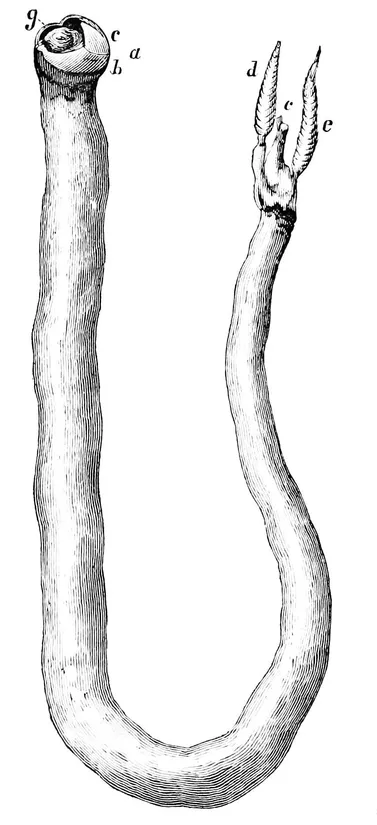
The naval shipworm is not a worm but a bivalve that lives inside submerged wood. Its tiny shell-covered front end drills tunnels while the long body feeds and breathes inside the tunnel.
Not a fish · an aquatic neighborWater
Saltwater + Brackish
Submerged timber, driftwood, pilings, docks, and wooden ships in marine and estuarine water.
Temperature
15–25°C · 59–77°F
This is the reported optimal temperature range, not a universal survival range.
Size
Usually about 20 cm (8 in) long; reported range 1.5–58 cm (0.6–23 in)
A typical adult is about as long as a pencil
Lifespan
About 1–3 years.
Life expectancy varies with place, conditions, and what scientists have been able to observe.
01 · Signature adaptation
What does it do?
Larvae swim freely until they settle on wood and transform into adults. Adults remain in their tunnels, changing direction when they approach a neighboring tunnel or the end of the timber.
02 · Home coordinates
Where does it live?
Now widespread in temperate and tropical seas, including the Atlantic, Pacific, Baltic, and many coastal regions reached through shipping.
Regions: Atlantic Ocean · Pacific Ocean · Baltic Sea · Global introduced range
03 · The menu
What does it eat?
Its shell scrapes wood into particles, while cilia move the particles toward the mouth; siphons can also collect plankton.
Wood-eater and filter feeder: wood particles, phytoplankton, microbes.
04 · Remember this
Two wow facts
A clam in disguise
Although its body looks worm-like, its drilling end carries two small bivalve shells.
Sources [1] [2]
Living wood drill
It lines its burrow with a hard calcareous coating that helps protect and support the tunnel.
Sources [1]