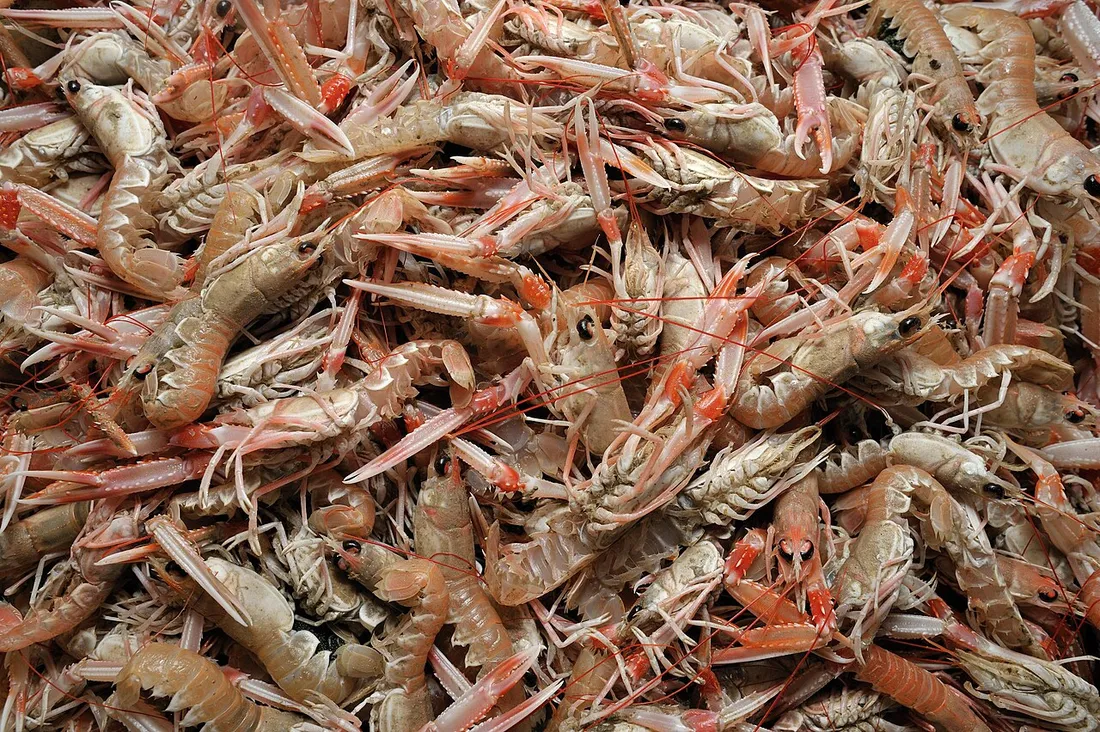
 Photo: Olivier Dugornay (IFREMER, Pôle Images, Centre Bretagne - ZI de la Pointe du Diable - CS 10070 - 29280 Plouzané, France) · Image source ·CC BY 4.0
_(Ifremer_00574-68636_-_53250).jpg)
Animal profile · Crustaceans · Burrowing lobster
Norway lobster
Nephrops norvegicus
The Norway lobster is a small, pale-orange lobster that lives in muddy seafloor burrows. It has distinctive kidney-shaped eyes and long slender claws.
Not a fish · an aquatic neighborWater
Saltwater
Muddy continental-shelf and slope sediments where it occupies burrows.
Temperature
Range not established
A dependable species-specific wild temperature range was not established from the reviewed sources, so both values are null.
Size
Up to about 25 cm (10 in) long
About the length of a pencil
Lifespan
Best-supported wild lifespan is not established.
Life expectancy varies with place, conditions, and what scientists have been able to observe.
01 · Signature adaptation
What does it do?
It spends much of its time inside a muddy burrow. It is most active outside the burrow during low-light periods and can be caught with traps or trawls.
02 · Home coordinates
Where does it live?
Northeast Atlantic from Morocco to northern Norway and across the western Mediterranean.
Regions: Northeast Atlantic · Western Mediterranean
03 · The menu
What does it eat?
It leaves its burrow to seize small seafloor animals and scavenge.
Carnivore and scavenger: crustaceans, mollusks, polychaete worms, carrion.
04 · Remember this
Two wow facts
Kidney-shaped eyes
Its genus name refers to the unusual kidney-like shape of its eyes.
Sources [1]
Burrow specialist
It is closely associated with muddy sediments that allow it to dig shallow burrows.
Sources [2]