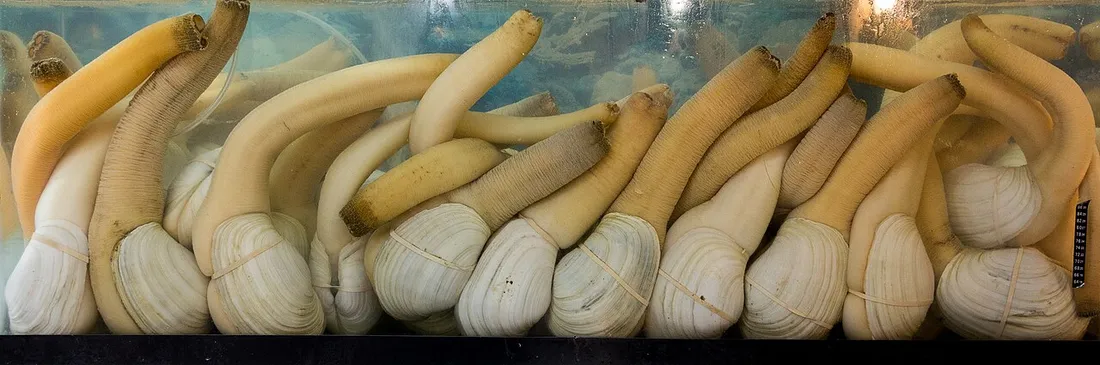
 Photo: Tomascastelazo · Image source ·CC BY-SA 4.0
Animal profile · Mollusks · Burrowing clam
Pacific geoduck
Panopea generosa
Pacific geoducks are giant clams with small shells and remarkably long siphons. They spend most of their lives buried in coastal sediment while filtering food from the water.
Not a fish · an aquatic neighborWater
Saltwater
Intertidal and shallow subtidal sand, gravel, and muddy sediments.
Temperature
Range not established
A dependable species-specific wild temperature range was not found in the selected sources.
Size
Shell typically 15–20 cm (6–8 in); siphon up to about 91 cm (3 ft)
The siphon can be about as long as a tall child
Lifespan
Can live for more than 100 years; the oldest recorded specimen was 168 years old.
Life expectancy varies with place, conditions, and what scientists have been able to observe.
01 · Signature adaptation
What does it do?
Adults remain buried and mostly stationary in the sediment. They broadcast-spawn, releasing eggs and sperm into the water, while young larvae drift before settling.
02 · Home coordinates
Where does it live?
Along the northeastern Pacific coast from Alaska to Baja California.
Regions: Alaska · British Columbia · Pacific Northwest · Baja California
03 · The menu
What does it eat?
It draws water through its siphon and gills, trapping tiny particles as food.
Filter feeder: phytoplankton, suspended organic particles, microalgae.
04 · Remember this
Two wow facts
Century-old clam
Some Pacific geoducks live for well over a century.
Sources [1]
Millions of eggs
A female can release between one and two million eggs in a spawning event.
Sources [1]