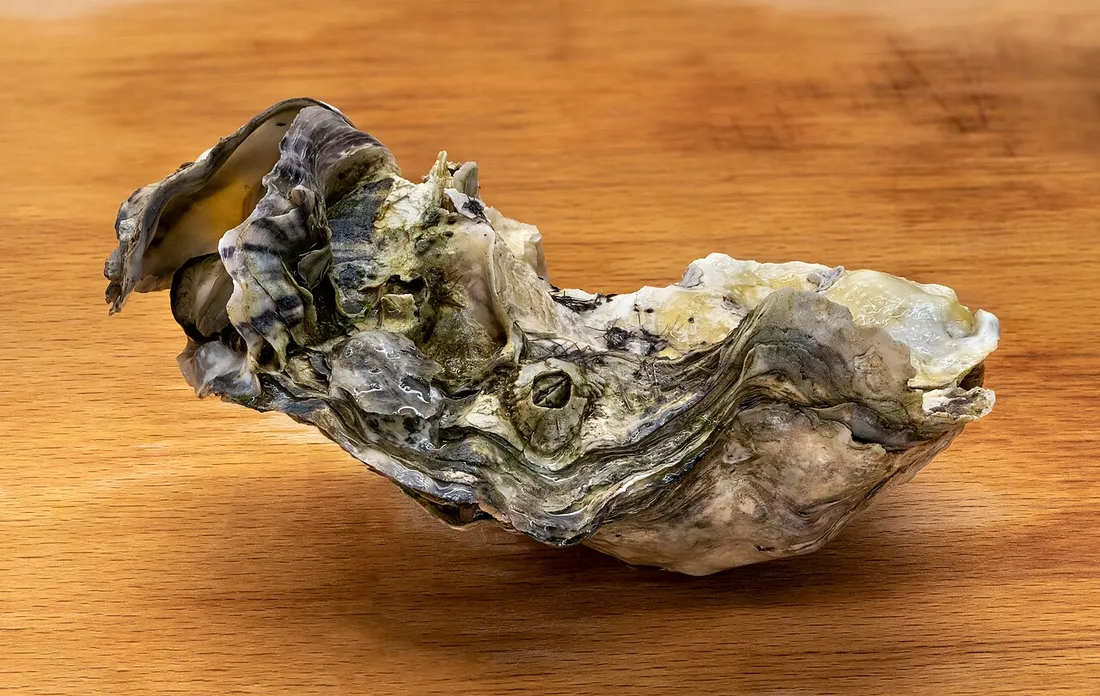
 Photo: W.carter · Image source ·CC BY-SA 4.0
Animal profile · Mollusks · oyster
Pacific oyster
Magallana gigas
The Pacific oyster is a hard-shelled bivalve native to the western Pacific. It attaches to firm surfaces and filters microscopic food from coastal water.
Not a fish · an aquatic neighborWater
Saltwater + Brackish
Intertidal and shallow coastal waters on firm bottoms, reefs, and estuaries.
Temperature
Range not established
A dependable species-specific wild temperature range was not found; values are left unreported.
Size
Typically 8–40 cm (3–16 in), up to about 30 cm (12 in)
A large one can be about the length of a dinner plate
Lifespan
Up to about 10 years
Life expectancy varies with place, conditions, and what scientists have been able to observe.
01 · Signature adaptation
What does it do?
Adults remain fixed to their settlement surface and may form dense clusters or reefs. Its free-swimming larvae drift before settling and cementing themselves to a hard surface.
02 · Home coordinates
Where does it live?
Native to the western Pacific, especially Japan, Korea, China, and the Russian Far East; introduced and farmed in many other coastal regions.
Regions: Japan · Korea · China · Russian Far East · introduced coastlines worldwide
03 · The menu
What does it eat?
It filters tiny organisms and particles from seawater through its gills.
filter feeder: phytoplankton, microalgae, suspended organic particles.
04 · Remember this
Two wow facts
Global traveler
It is native to the western Pacific but has been introduced and farmed across many temperate coastlines.
Sources [1] [2]
Reef provider
Clusters of Pacific oysters can form reefs that provide habitat for fish and other invertebrates.
Sources [1]