 Photo: BrokenSphere · Image source ·CC BY-SA 3.0
Animal profile · Other aquatic life · sand dollar
Pacific sand dollar
Dendraster excentricus
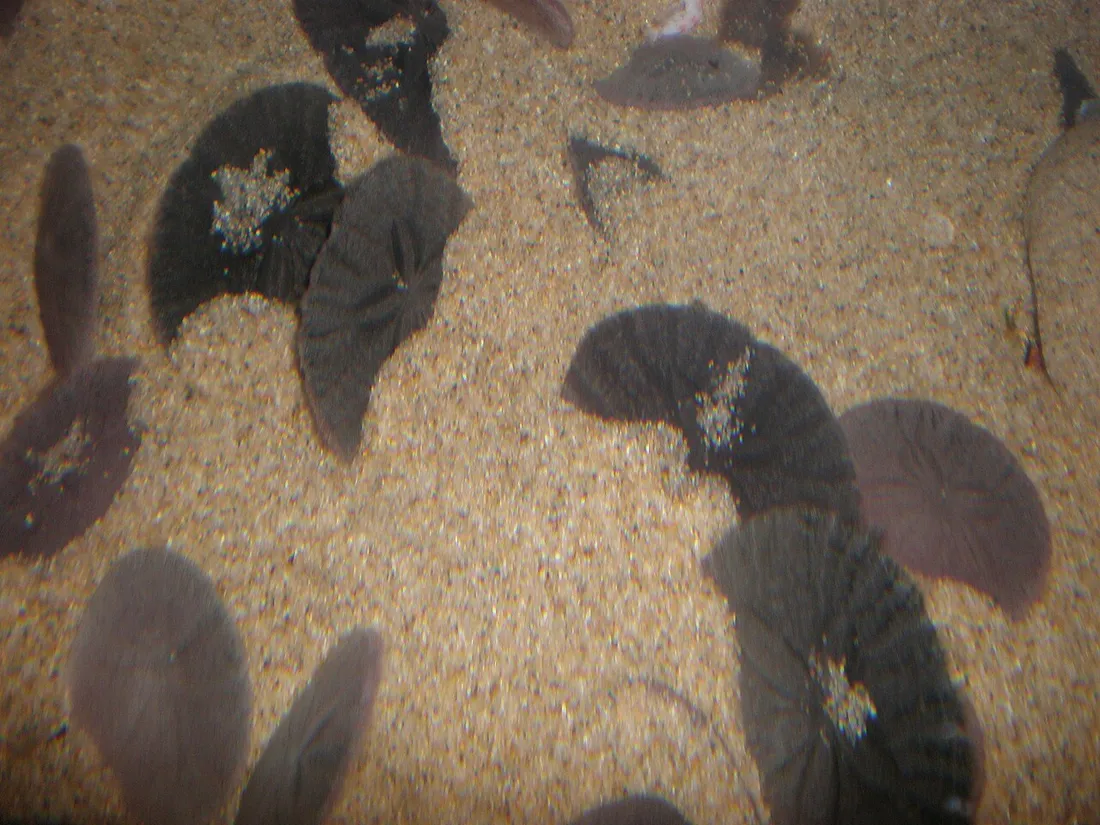
The Pacific sand dollar is a flattened echinoderm that lives partly buried in sandy coastal bottoms. Its off-center shape helps it feed while facing into moving water.
Not a fish · an aquatic neighborWater
Saltwater
Nearshore fine-sand flats, bays, protected beaches, and shallow coastal bottoms.
Temperature
Range not established
A dependable species-specific wild temperature range was not established from the reviewed sources.
Size
Up to about 10 cm (4 in) across
About the size of a cookie.
Lifespan
Not established in the wild
Life expectancy varies with place, conditions, and what scientists have been able to observe.
01 · Signature adaptation
What does it do?
Adults often live in colonies partly buried in sand. Their petal-like pattern is formed by tube-foot structures involved in gas exchange and feeding.
02 · Home coordinates
Where does it live?
Northeastern Pacific from British Columbia to Baja California.
Regions: British Columbia · Washington · Oregon · California · Baja California
03 · The menu
What does it eat?
It uses cilia, spines, and tube feet to collect suspended and deposited particles.
Suspension feeder: algae, larval crustaceans, detritus, plankton.
04 · Remember this
Two wow facts
Off-center design
Unlike many sand dollars, its profile is noticeably eccentric, helping it maintain a feeding position in current.
Sources [1]
Sand recycler
Its feeding removes algae, detritus, and small organisms from the ocean floor.
Sources [1] [2]