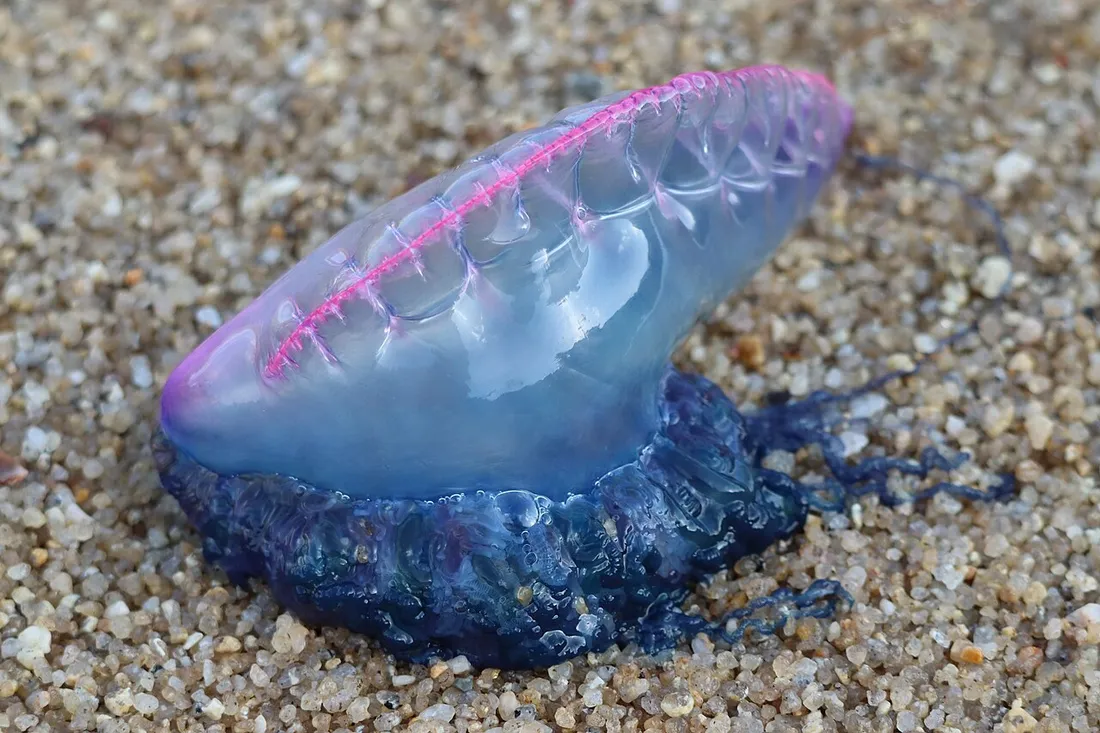
 Photo: Fernando Losada Rodríguez · Image source ·CC BY-SA 4.0
.jpg)
Animal profile · Other aquatic life · Siphonophore
Portuguese man o' war
Physalia physalis
The Portuguese man o' war is a floating colony of specialized animals, not a single jellyfish. A gas-filled float carries it across tropical and subtropical seas while tentacles below capture prey.
Not a fish · an aquatic neighborWater
Saltwater
Surface waters of tropical and subtropical oceans.
Temperature
Range not established
No dependable species-specific wild temperature range was located.
Size
Tentacles average about 10 m (33 ft) and may reach 30 m (100 ft)
Its longest tentacles can span the length of a basketball court.
Lifespan
Not established in the wild
Life expectancy varies with place, conditions, and what scientists have been able to observe.
01 · Signature adaptation
What does it do?
It cannot swim independently and travels with wind and currents. Large groups may drift together, sometimes numbering in the hundreds or more.
02 · Home coordinates
Where does it live?
Warm surface waters of the Atlantic, Pacific, Indian, and other tropical or subtropical oceans.
Regions: Atlantic Ocean · Pacific Ocean · Indian Ocean · Tropical and subtropical seas
03 · The menu
What does it eat?
Stinging tentacles immobilize prey, which feeding zooids digest and share with the colony.
Carnivore: small fish, fish larvae, small crustaceans.
04 · Remember this
Two wow facts
Many animals, one colony
A single man o' war is a colony of genetically identical zooids with different jobs.
Sources [1]
Sting after washing ashore
Its tentacles may still sting for weeks after the animal reaches a beach.
Sources [1]