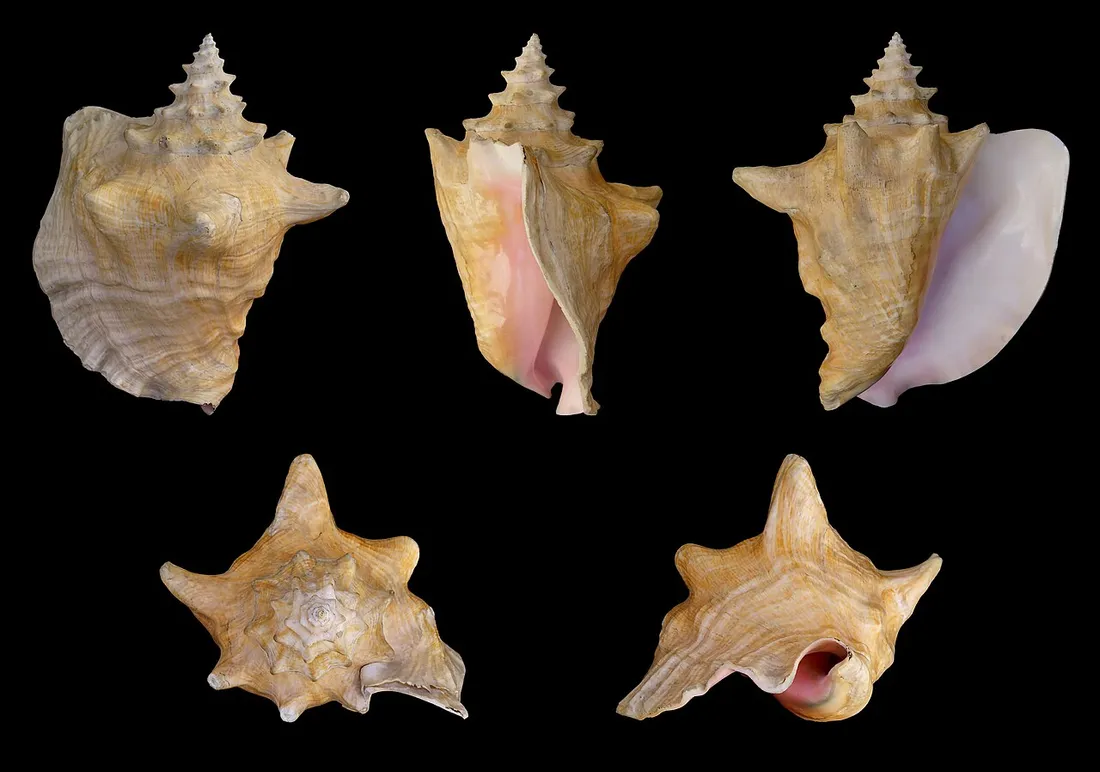
 Photo: H. Zell (original photographs and collage), Papa Lima Whiskey (derivative edit) · Image source ·CC BY-SA 3.0
Animal profile · Mollusks · Sea snail
Queen conch
Aliger gigas
Queen conchs are large Caribbean sea snails with heavy shells and bright pink or orange interiors. They graze across seagrass beds, sandy flats, and algal habitats.
Not a fish · an aquatic neighborWater
Saltwater
Shallow seagrass beds, sand flats, algal beds, coral rubble, and reefs.
Temperature
Range not established
A dependable species-specific wild temperature range was not found in the selected sources.
Size
Up to about 30.5 cm (12 in) long and 2.3 kg (5 lb)
About as long as a school ruler
Lifespan
Usually about 25–30 years.
Life expectancy varies with place, conditions, and what scientists have been able to observe.
01 · Signature adaptation
What does it do?
Queen conchs move slowly across the seafloor and often gather in groups. They need close contact to mate, so sparse populations can have difficulty reproducing.
02 · Home coordinates
Where does it live?
Throughout much of the Caribbean, the Florida Keys, Bermuda, and nearby tropical western Atlantic waters.
Regions: Caribbean Sea · Florida Keys · Bermuda · Flower Garden Banks
03 · The menu
What does it eat?
Adults graze algae and organic material from the seafloor with a rasping radula.
Herbivore: filamentous algae, epiphytic algae, diatoms, seagrass detritus.
04 · Remember this
Two wow facts
Eyes on stalks
Queen conchs have prominent eyes at the ends of long stalks.
Sources [1]
Drifting young
After hatching, their larvae drift in the water column for roughly three to four weeks before settling.
Sources [1]