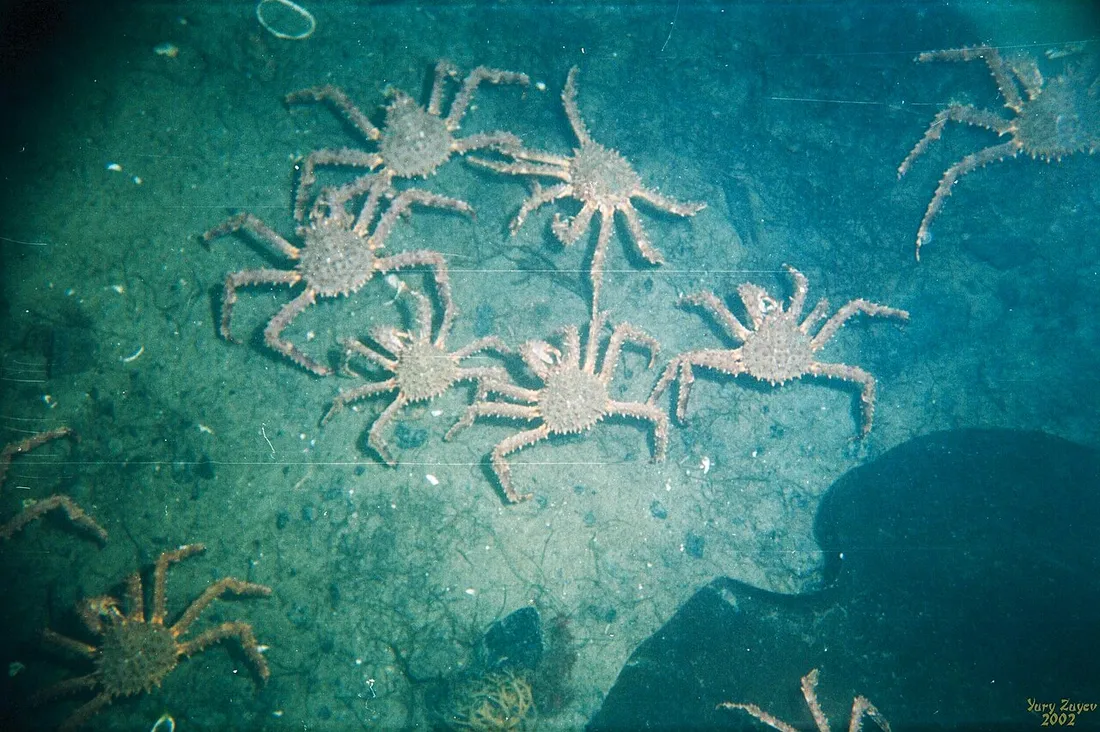
 Photo: Yury A. Zuyev · Image source ·Public domain
Animal profile · Crustaceans · King crab
Red king crab
Paralithodes camtschaticus
The red king crab is a large, spiny crab of cold northern seas. Juveniles hide in complex shallow habitat, while adults move into deeper shelf waters.
Not a fish · an aquatic neighborWater
Saltwater
Soft shelf sediments, shell hash, cobble, algae, and bryozoan habitat.
Temperature
Range not established
A dependable species-specific wild temperature range was not established from the reviewed sources, so both values are null.
Size
Up to about 28 cm (11 in) carapace width; leg span over 1.5 m (5 ft)
Its legs can span wider than a doorway
Lifespan
Best-supported wild lifespan is not established.
Life expectancy varies with place, conditions, and what scientists have been able to observe.
01 · Signature adaptation
What does it do?
Juveniles form pods that may contain tens of thousands of crabs. Adults feed mainly on the seafloor, and females move shallower to hatch their eggs.
02 · Home coordinates
Where does it live?
Bering Sea, Aleutian Islands, Gulf of Alaska, and south to British Columbia; introduced to the Barents Sea.
Regions: Bering Sea · Aleutian Islands · Gulf of Alaska
03 · The menu
What does it eat?
Young crabs eat small organisms and algae; adults crush a broad range of bottom prey.
Omnivore: worms, clams, mussels, barnacles, fish, sea stars, carrion.
04 · Remember this
Two wow facts
Crab supergroups
Young red king crabs can gather in pods containing tens of thousands of individuals.
Sources [1]
Spiny defense
Sharp spines cover the shell and legs, making the crab difficult for many predators to swallow.
Sources [1]