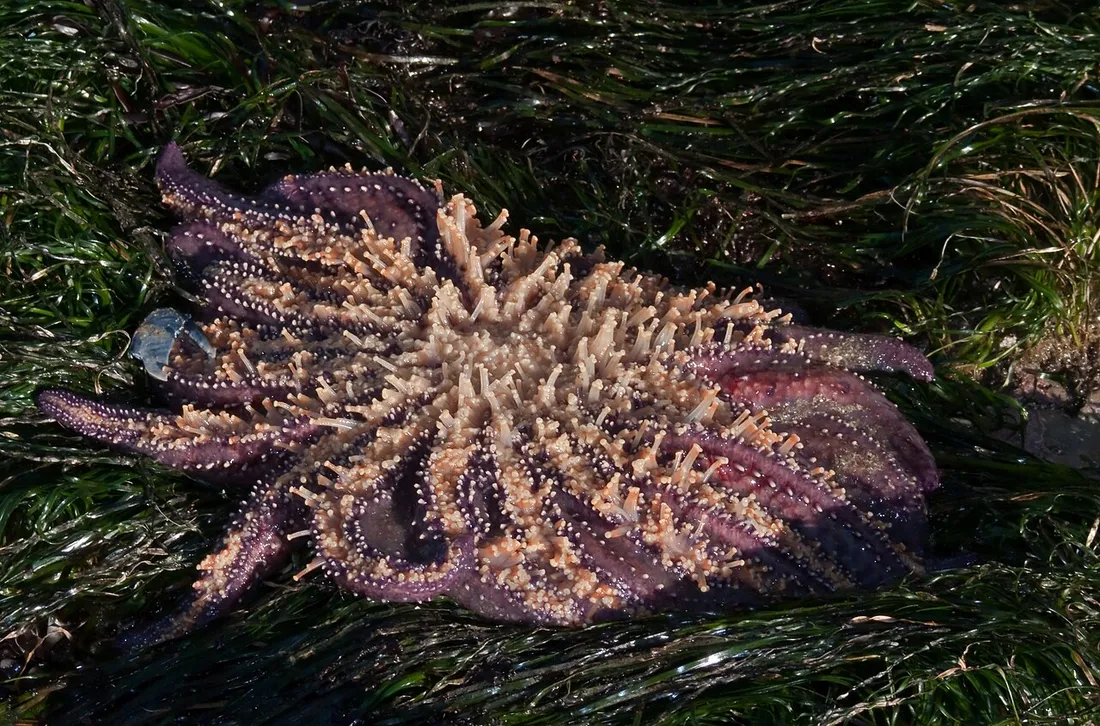
 Photo: "Mike" Michael L. Baird · Image source ·CC BY 2.0
Animal profile · Other aquatic life · sea star
Sunflower sea star
Pycnopodia helianthoides
The sunflower sea star is a very large, fast-moving sea star with many flexible arms. It is a major predator of sea urchins and other seafloor animals.
Not a fish · an aquatic neighborWater
Saltwater
Temperate rocky reefs, kelp forests, outer coasts, and protected coastal waters.
Temperature
Range not established
A dependable species-specific wild temperature range was not established from the reviewed sources.
Size
More than 90 cm (3 ft) across
About as wide as a large serving tray.
Lifespan
Not established in the wild
Life expectancy varies with place, conditions, and what scientists have been able to observe.
01 · Signature adaptation
What does it do?
It crawls actively rather than drifting and can use its many arms to surround prey. Its decline has allowed sea urchins to increase in some places, contributing to kelp loss.
02 · Home coordinates
Where does it live?
Northeastern Pacific Ocean from Alaska to at least Baja California.
Regions: Alaska · British Columbia · Pacific Northwest · California · Baja California
03 · The menu
What does it eat?
It actively hunts and consumes a wide range of invertebrates on the seafloor.
Carnivore: sea urchins, clams, crabs, snails, other sea stars.
04 · Remember this
Two wow facts
Largest sea star
It is among the world's largest sea stars, reaching more than 3 feet across.
Sources [2] [1]
Kelp protector
By eating sea urchins, it helps prevent excessive grazing in kelp forests.
Sources [3] [1]