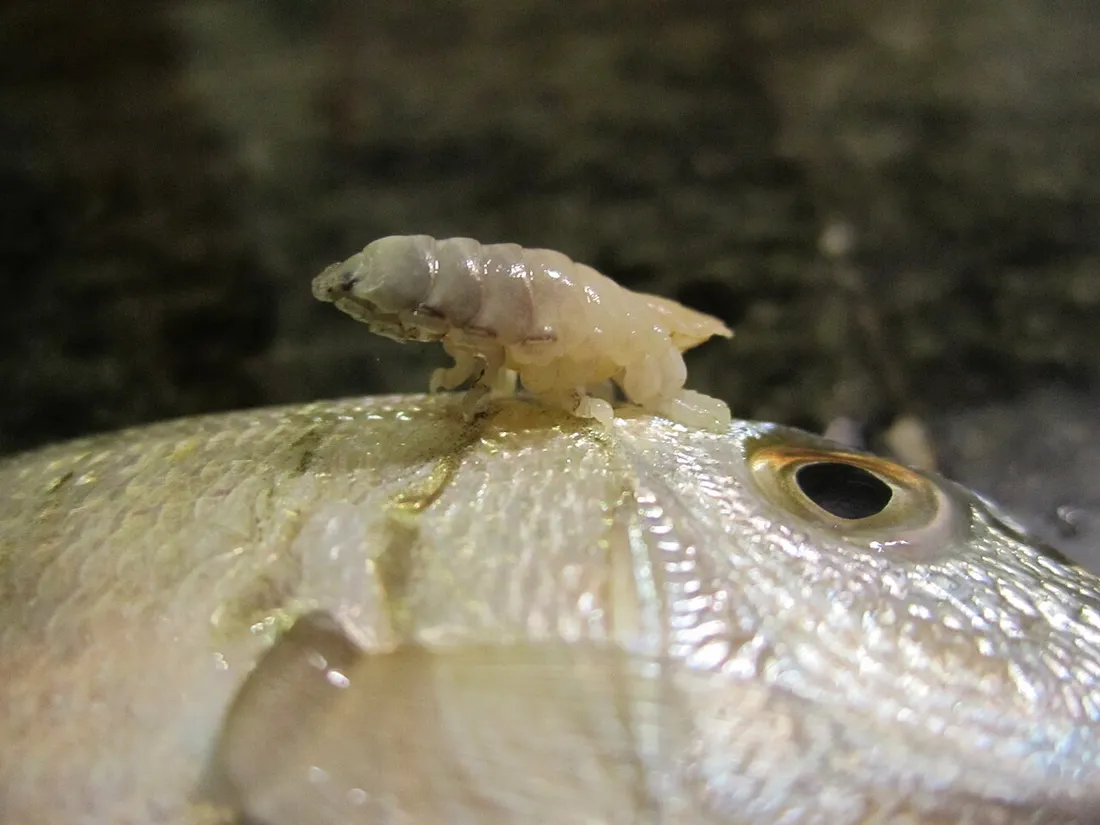
 Photo: Marco Vinci · Image source ·CC BY-SA 3.0
Animal profile · Crustaceans · Parasitic isopod
Tongue-eating louse
Cymothoa exigua
The tongue-eating louse is a parasitic isopod that enters a fish through the gills. It attaches to the tongue, causes the tongue to wither, and then occupies its place.
Not a fish · an aquatic neighborWater
Saltwater
Marine waters associated with reef and coastal fishes.
Temperature
Range not established
A dependable species-specific wild temperature range was not established from the reviewed sources, so both values are null.
Size
Up to about 3 cm (1.2 in) long
About the length of a paperclip
Lifespan
Best-supported wild lifespan is not established.
Life expectancy varies with place, conditions, and what scientists have been able to observe.
01 · Signature adaptation
What does it do?
A juvenile enters through the gills and changes sex as it matures. The female anchors to the tongue while the male usually remains behind her in the mouth cavity.
02 · Home coordinates
Where does it live?
Eastern Pacific coastal waters, especially around host fishes such as snappers.
Regions: Eastern Pacific · Tropical and subtropical coastal waters
03 · The menu
What does it eat?
It feeds on blood and fluids from the host fish while remaining attached in the mouth.
Blood-feeding parasite: fish blood, host tissue fluids.
04 · Remember this
Two wow facts
Tongue substitute
After the fish tongue shrinks, the attached female isopod can act as a functional replacement.
Sources [1]
Sex-changing parasite
Young individuals mature as males and may later become females depending on social conditions.
Sources [1]