 Photo: No machine-readable author provided. Svdmolen assumed (based on copyright claims). · Image source ·CC BY-SA 3.0
.JPG)
Animal profile · Other aquatic life · Jellyfish
Upside-down jellyfish
Cassiopea xamachana
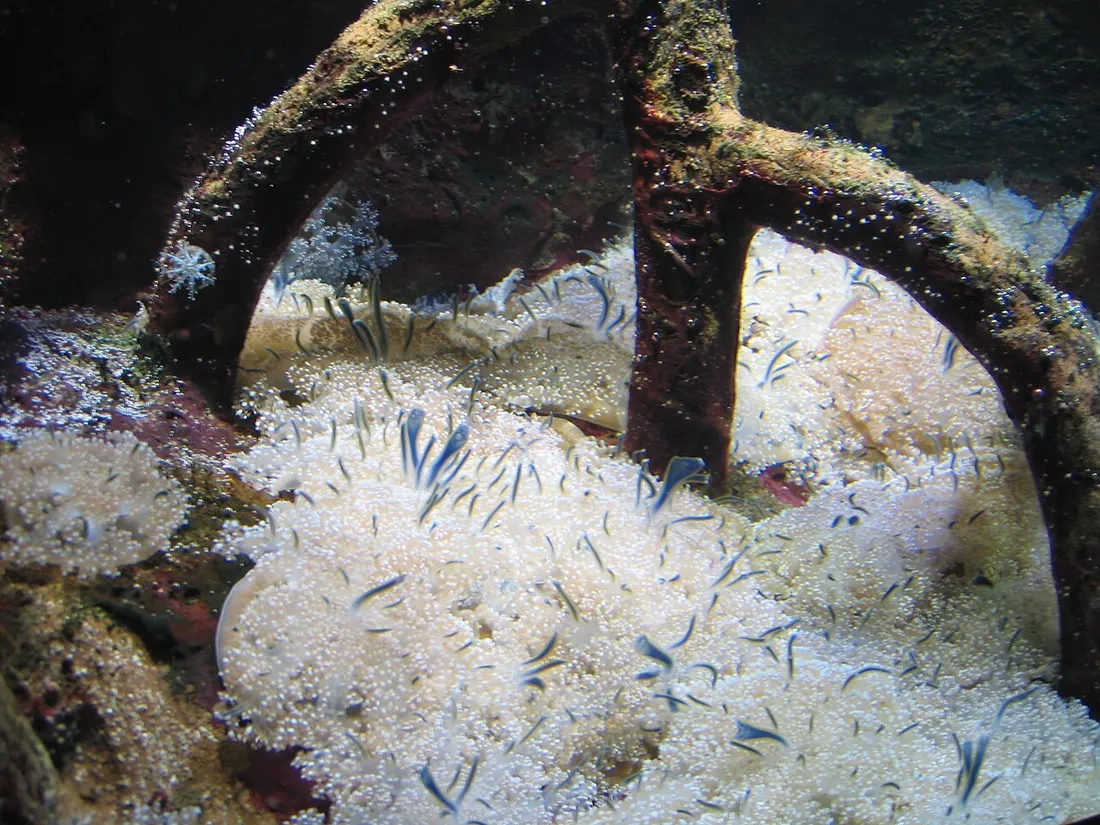
The upside-down jellyfish rests on the seafloor with its oral arms pointing upward. It lives in warm, shallow, sunlit coastal water and often gathers near mangroves.
Not a fish · an aquatic neighborWater
Saltwater + Brackish
Shallow, sunlit coastal bottoms, especially mangrove-associated lagoons and bays.
Temperature
Range not established
No dependable species-specific wild temperature range was located.
Size
Bell up to 36 cm (14 in) wide
About as wide as a serving plate.
Lifespan
Not established in the wild
Life expectancy varies with place, conditions, and what scientists have been able to observe.
01 · Signature adaptation
What does it do?
It is largely sedentary and pulses on its bell while resting on the bottom. Groups can release mucus containing tiny stinging structures that irritate nearby swimmers.
02 · Home coordinates
Where does it live?
Warm western Atlantic waters, including the Caribbean, Florida, and the Gulf of Mexico; also reported from Hawaii.
Regions: Caribbean · Florida · Gulf of Mexico · Hawaii
03 · The menu
What does it eat?
It catches small plankton and also receives energy made by algae living in its tissues.
Omnivore: zooplankton, photosynthetic symbiotic algae.
04 · Remember this
Two wow facts
Stinging mucus
It can release mucus containing tiny stinging structures, causing irritation without direct contact.
Sources [1]
Lives upside down
Instead of floating with its arms below, it rests on the seafloor with its arms facing the sunlight.
Sources [2]