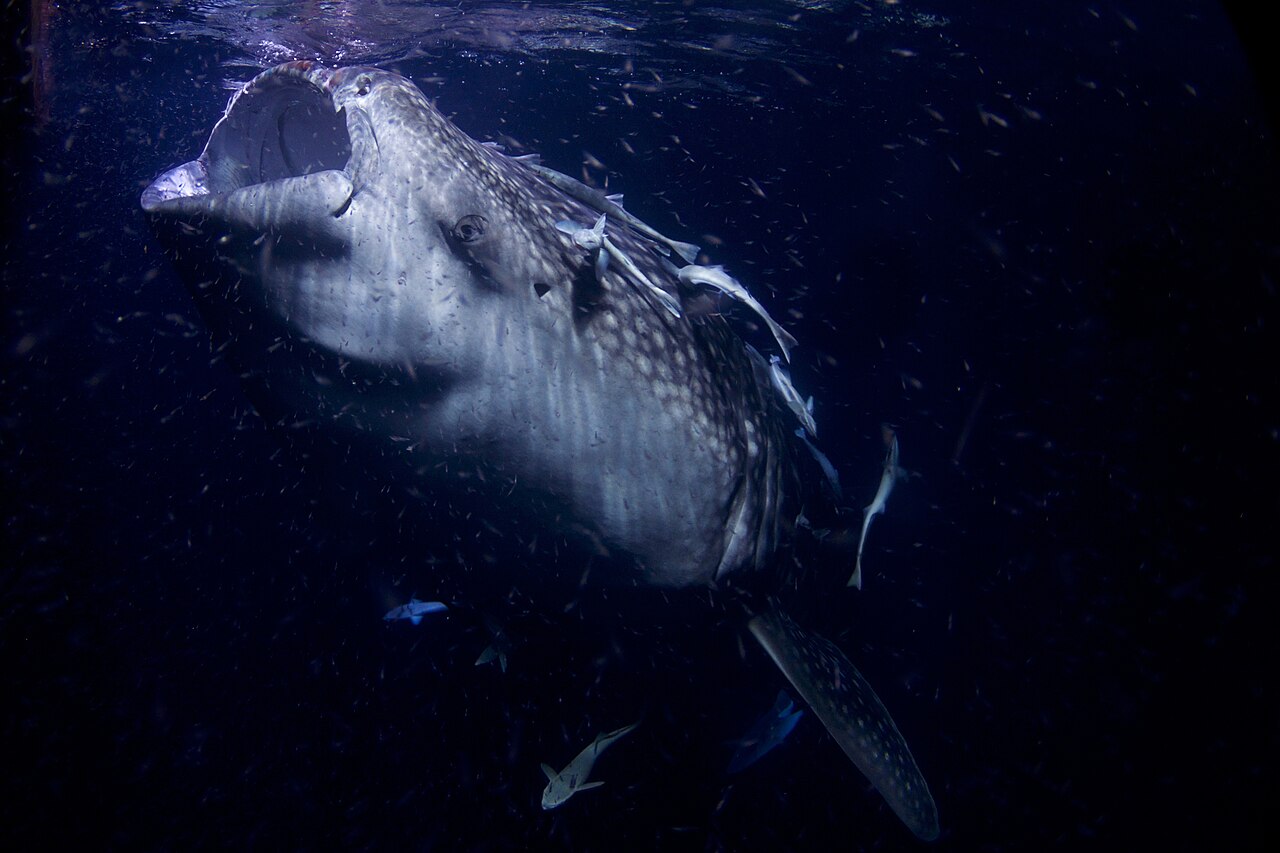
 Photo: Arturo de Frias Marques · Image source ·CC BY-SA 4.0
Animal profile · Fish · Sharks and rays
Whale shark
Rhincodon typus
The whale shark is the largest fish alive today. Even though it is enormous, it is a filter feeder that gathers mouthfuls of tiny prey.
✓ This really is a fishWater
Saltwater
Warm tropical and subtropical seas, both offshore and near productive coasts and coral atolls.
Temperature
20–25°C · 68–77°F
Often seen in this warm range, though tagged sharks can dive into much colder deep water.
Size
Commonly up to 12.2 m (40 ft); exceptional reports are larger
About as long as a school bus
Lifespan
At least 75 years; scientists think some may live beyond 100
Life expectancy varies with place, conditions, and what scientists have been able to observe.
01 · Signature adaptation
What does it do?
Whale sharks often cruise slowly near the surface where food gathers. They can also travel huge distances and make very deep dives.
02 · Home coordinates
Where does it live?
Warm oceans around the world, with seasonal gathering places near coasts in Mexico, Australia, the Philippines, and other regions.
Regions: Atlantic Ocean · Indian Ocean · Pacific Ocean
03 · The menu
What does it eat?
It strains tiny drifting animals and small fish from the water instead of biting large prey.
Filter feeder: plankton, krill, fish eggs, small schooling fish.
04 · Remember this
Two wow facts
Shark, not whale
Its name comes from its whale-like size and feeding style, but it has cartilage instead of bone and is truly a shark.
Sources [1] [4]
Spot fingerprint
Every whale shark has a unique pattern of pale spots, allowing researchers to recognize individuals in photographs.
Sources [3]